WHICH?
Pigment Characteristics

Did I mention that pigments are small particles (practically) insoluble in either oils, resins or water? Of course, I know I’ve just said this, but as you’ll now hear—and although that’s virtually their only common denominator—even that is not always accurate. Because some artists’ pigments are not pigments, they are dyes… in disguise. Dyes, as you probably know, are also colouring materials but soluble. You can paint and draw with dyes. Dyes fill all fountains pens, most felt pens, and there is even a range of highly colourful liquid dyes available in art stores called Ecoline. These offer illustrators ease of use, a colour consistency (that little girl’s dress is the same green on every page), and a brushless matt and intense result not so easily attainable with watercolours, for example. Usually, too, these artists do not care so much about longevity as their work, used digitally, will be scanned and then discarded or stashed in a folder.
Strangely enough, medieval manuscript ‘illustrators’ seemed to have come to the same conclusion—as fading is not such an issue for illuminations that rarely see the light of day, staying safely tucked inside a book. Simple juices or decoctions from seeds or berries produced such beautiful transparent colours that they were deemed, indeed, use-ful, and often were then. Still, the question remained of how to use and preserve them beyond their season (probably before they soured, rotted or fermented too.) Well, when strips of cloth were dipped into the liquids, left to dry, and the process repeated a few times, they became saturated enough to be used as a watercolour pan of sorts. Rewetted, these clothlets, as they were called, delivered an acceptable ink substitute that offered subtle glazes and washes quite different from the sort of ‘gouache’ then in use. Furthermore, other hues could be produced from the same colour batch if the cloth was exposed to ammonia or first dipped into lime. Clever, wasn’t it? And pretty handy! (So much so that their other name was folium, as you could easily store them between pages.)1
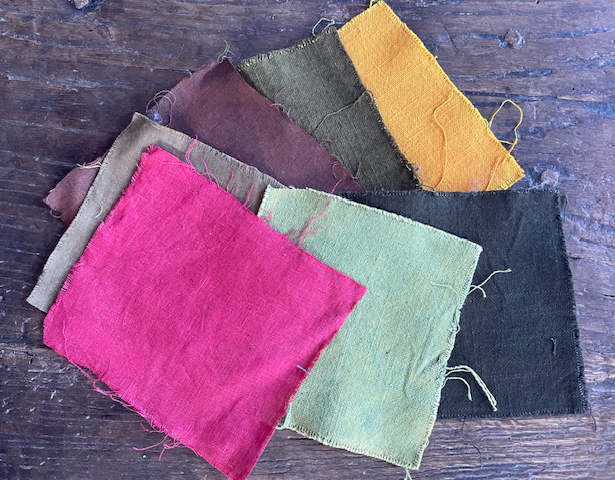
Being particle-less, dyes are indeed something of an ink and most suitable for colouring paper or textiles as they are easily absorbed into fibres. Their loss of a physical crystalline or particulate structure as they dissolve, doesn’t mean that their chemical composition is very different from pigments’. The only true inconvenience really is that you cannot disperse that liquid colour directly into wax, egg, gum or oil to turn it into a usable paste/paint—one which would impart a vibrant colour, not migrate between layers and adhere to canvas, wooden panels and what not we have used as supports over the centuries.
Yet, despite our ingenuity in colour chasing, we have found some colour spaces singularly lacking in adequate pigments, whereas dyes sometimes existed for these. So a smart answer was found. Dyes, often already obtained by all manners of long and complicated processes, could be turned into pigments by the addition of an inert insoluble ingredient—transparent or not, depending if body and opacity were needed—such as chalk, alum or hydrated clay (an alum solution with the addition of a potash solution.) When dry, these would have absorbed the liquid and could be ground like any mineral pigment. (Rules were a bit laxer in ancient times, and these laked pigments were part of the Art Club then, tolerated despite their shortcomings.)
The whole thing was/is quite a process, really, but worth the effort for rarer colours and for the incredible variety of hues you can extract from the one dye with minor changes to concentration, temperature, PH levels, etc. Also, compared to what was available back then, lake pigments are transparent and ideal for glazing. Add some cold-pressed linseed oil, a bit of Damar varnish, a great deal of patience and layer upon layer will eventually give that depth and jewel-like quality you so sought after. Among the most famous ones, still on the shelves today because they are irreplaceable to some watercolourists, are two madder lakes: Rose Madder genuine and Alizarin Crimson genuine—even though they perform even less well in gum Arabic than in oil. All the others have become obsolete and natural lakes have become a thing of the past in today’s paint world where lightfastness is a prerequisite.
Because even if we now know how, with proper preparation and the use of mordants, to make natural dyes quite colourfast, these are, by nature, no less fugitive than those of yesteryear, and Light will always fade them. Usually, quite gracefully, it must be said! Whereas stains, unfortunate stains… like that spinach one on the bib, will first turn another colour when washed, then, wash after wash, weird hue after weird hue, they will fade on the whole rather disgracefully.

Today, and even if most Modern organic pigments are, in fact, synthetic dyes, these are mostly lightfast—an (in)famous exception is fluorescent pigments which are dyes dissolved into a resin and not lightfast at all. Nobody knows their dirty secret much, but I’ll give you a clue you can notice when you’re washing your brushes as pigments will wash away, whereas these synthetic dyes are really staining! The technique hasn’t really changed, precipitation onto an inert binder, but nowadays, it’s usually a metallic salt—typically chromium or cobalt. The particles attached thus, chemically or often electrically, are still ‘dyes in disguise’ and should technically be called lake pigments. In some countries’ industrial paint literature, that is the case, in others, they are referred to as toners, but in the art world, we call them pigments—the term lake generally used for the Historical ones only.
Jump to the next section of the book by clicking here
Alternatively click on the Table of Contents to browse the sections.
You can also subscribe to my blog at the bottom of this page,
and you’ll receive Hues in Tubes in your inbox… as it gets published!
Additional information & references
- If you might have an interest in making your clothlets, here’s a good place to start: [Online]. [Accessed 28 January 2025] https://dragonflyscribeblog.wordpress.com/2020/12/13/what-is-a-clothlet/
↩︎
Discover more from in bed with mona lisa
Subscribe to get the latest posts sent to your email.
 in bed with mona lisa
One Comment Add yours