WHICH?
Pigment Characteristics
(I feel like giving you a warning that this section is for those really interested in that stuff!)
Equipped with an understanding of their chemical nicknames, let’s now go back to the four black pigments/paints commonly found in art stores: Carbon and Lamp Black, Ivory and Bone Black, and tackle the four characteristics we were discussing: Organic/Inorganic, Natural/Synthetic.
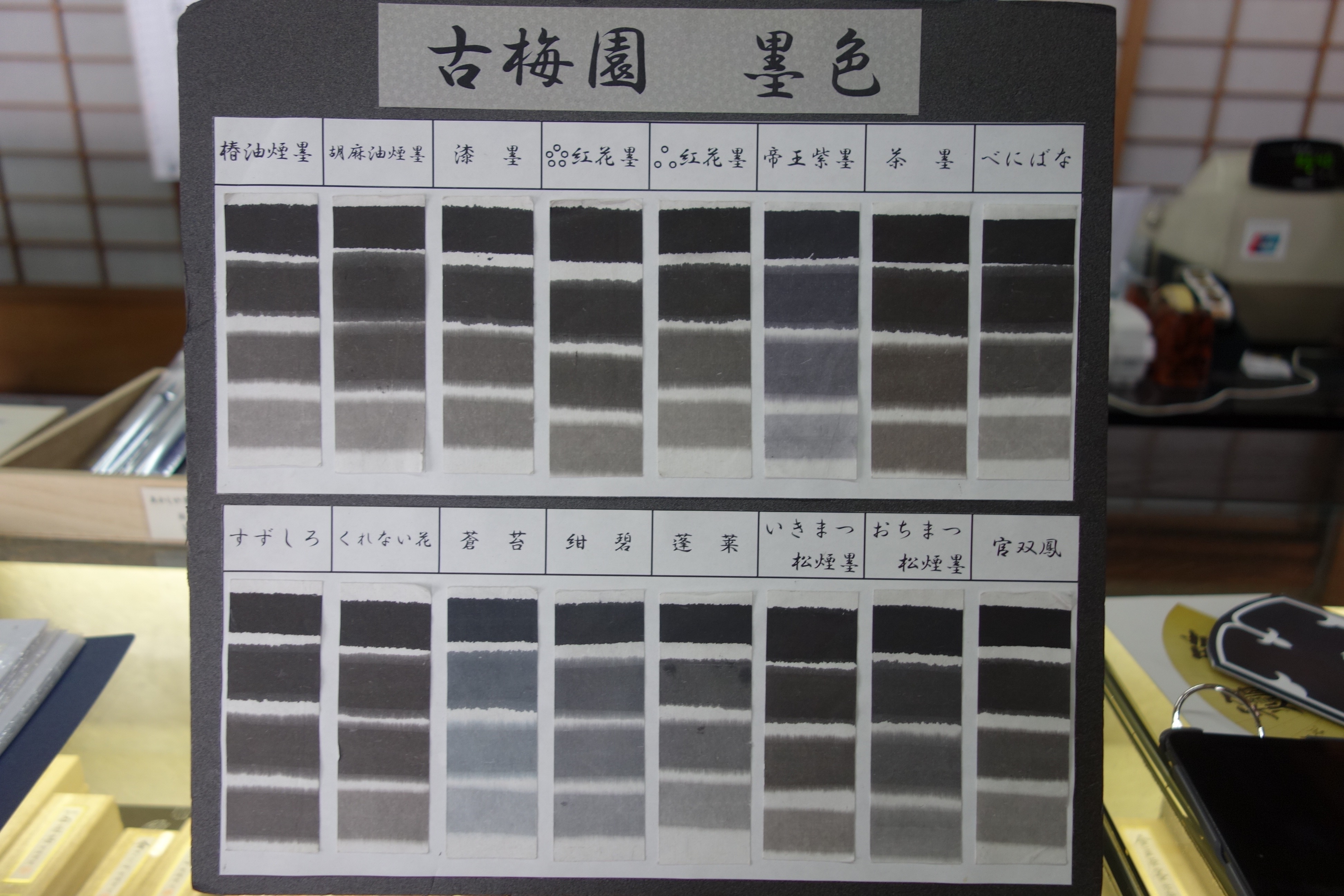
Onwards to Lamp Black, an ancient soot pigment that has reached a degree of finesse in its variations, comparable to no other, I believe. You will read later a full description of how Lamp Black used to be made and how, when produced traditionally, every detail counted and still does. The quality of the oil, which has an incidence on the soot’s darkness and hue… bluish, greyish, black and blacker still, but also the length of the wick, as the faster the burning, the less fine the pigment particles. Nowadays, even if here and there on the planet, the pigment is still made in this traditional manner for ink connoisseurs; on the whole, Lamp Black is a different affair. Produced industrially, in furnaces, the paint in your tube is the residue of burning mineral oil, tar, naphthalene or other petroleum products… still, they’re all fossil fuels, right? And should still be all organic, surely. I’ve found one exception: Natural Pigments listing it as synthetic and inorganic. Everywhere else, this one is considered natural and organic. Its colour index is sometimes PBk7, 77266 and sometimes PBk6 -77266, while Carbon Black is, in most companies, PBk7 -77266, but sometimes PBk6 -77266 too! Although there must be some chemical difference between PBk6 and 7 (otherwise, they would group under the same number), Carbon and Lamp’s names seem pretty interchangeable! Carbon Black on a tube is a recent one, which appeared in the 1930s, and an imprecise name because it neither defines its components nor its extraction method. Still, it seems that most of the time, the Carbon Black which steals the umbrella name refers to one process in particular: soot formed from the incomplete combustion of natural gas. I know it’s confusing. But that’s not the end of it… Langridge labels it a natural organic pigment, R&F, too, whereas most others seem to agree it’s inorganic and natural.

Neither ivory nor bones really trigger images in black, of black… except perhaps in painters’ minds where the quasi-contradictory labels of Ivory and Bone Black are some of the most used. At first, ivory brought to me images of mammoths, primal hunts, violence perhaps, but also victory against the odds—not unlike the conquest of colour, come to think of it. These little men somehow skilled and savvy enough to trick the massive, dangerous beasts into their pits.
In Pliny’s days, Ivory Black was evidently still made with tusks, as it went by the name of Elephantimum but, already in the 17th century, the Dutch were using walrus teeth and deer antlers instead of the good stuff. Still, the total subterfuge seems to have happened around the end of the 19th century, at which time we had run out of ivory altogether, so paint companies switched products but not names! Did anyone notice? They must have as genuine Ivory Black, a finer pigment than Bone Black, turns into a deeper, more delicious ‘smoky’ black, but no Black Friday or Deaths ensued. The recipe for either is the same: the material is coked in airtight conditions, and the residue is powdered to make the paint. So far, so good, even if a bit cheeky, but I get that the word “ivory” has an aura “bone” doesn’t quite have.
But talk of the origin of materials… did it ever cross my mind what Ivory Black genuine was made of these days? I presumed the one I bought was from some sustainable source, but life has more imagination than we do. When making a film at Cornelissen, Lucy revealed mine/theirs was actually made from… old piano keys! They were offered a stash of them and then asked someone to charr them, as should be done. How hilarious! Does my paint remember being an elephant’s tusk? Or the pain of being the false note, for that matter? Not that a note can be intrinsically false, of course. You might think me odd to entertain these thoughts, but, in my defence (another word for tusk in French), they do say elephants have an especially good memory!

OK, so most companies give Ivory/Bone Black the Color Index Name PBk9, 77267, except a couple which name it PBL9, a mistake no doubt as the nomenclature PBL does not exist in that system. Having scanned all the good brands that give the classification, this is my confusing catch: R&F labels it a natural organic pigment, Natural Pigments in its Rublev oil paint, and Bruce MacEvoy in his handprint.com blog, too. I would tend to agree with them. It was once alive, then was charred, a transformation we have seen in ochres/Burnt Sienna or Umber not judged sufficient to justify the switch to synthetic. Unfortunately, the same company, Natural Pigments, labels their Ivory Black dry pigment as synthetic and inorganic. Could it be a different pigment from the one used in their paint? Or could it be that they have changed how they interpret these categories? (cf later) At the same time, Maimeri seems to agree with the inorganic and Golden, which actually calls it Bone Black, goes along with that bit but labels it as inorganic and… natural! (I’ve yet to find an organic synthetic Ivory Black, but I’ll keep looking.)
Lord! I hope I’ve confused you as much as I have been baffled by all these permutations. Yet I realise you haven’t seen many synthetics go by in all this whorl. Mars Black is certainly one everyone agrees on, and Manganese Black is usually synthetic too these days, so that’s two safe ones. But, in fact, most colours today are artificially produced, and you are more than likely to see variations only from Organic (made from fossil fuels) to Inorganic (a combo of ores and raw chemicals) than meet a Natural on a label.
I also cannot help thinking there might be a mistake here and there, an unfortunate copy/paste, but I suspect an agreement on how we classify would eliminate some variations too. Natural Pigments, for instance, justifies its Ivory Black not only as inorganic but synthetic thus: “We label it as an inorganic pigment (…) because the resulting product from bone char mainly consists of hydroxyapatite, calcium carbonate, and carbon, all of which are considered to be inorganic substances. Hydroxyapatite, also known as bone mineral, is a naturally occurring mineral form of calcium apatite. Although naturally-derived, it is a synthetic substance since it has been altered by human intervention, namely it was charred in a kiln.” Personally, I find interesting to know where materials come from but why not indeed decide we consider the end product rather than its starting point? If the man-made transformation is radical enough as to alter the pigment’s final chemical components/composition, then the process and its result win the ribbon… as long as we all agree!
On the other hand, I do have a black bone to pick with the other two categories: Natural vs Synthetic. I’ll make my case with genuine Vermillion, the synthetic equivalent of the natural pigment Cinnabar.
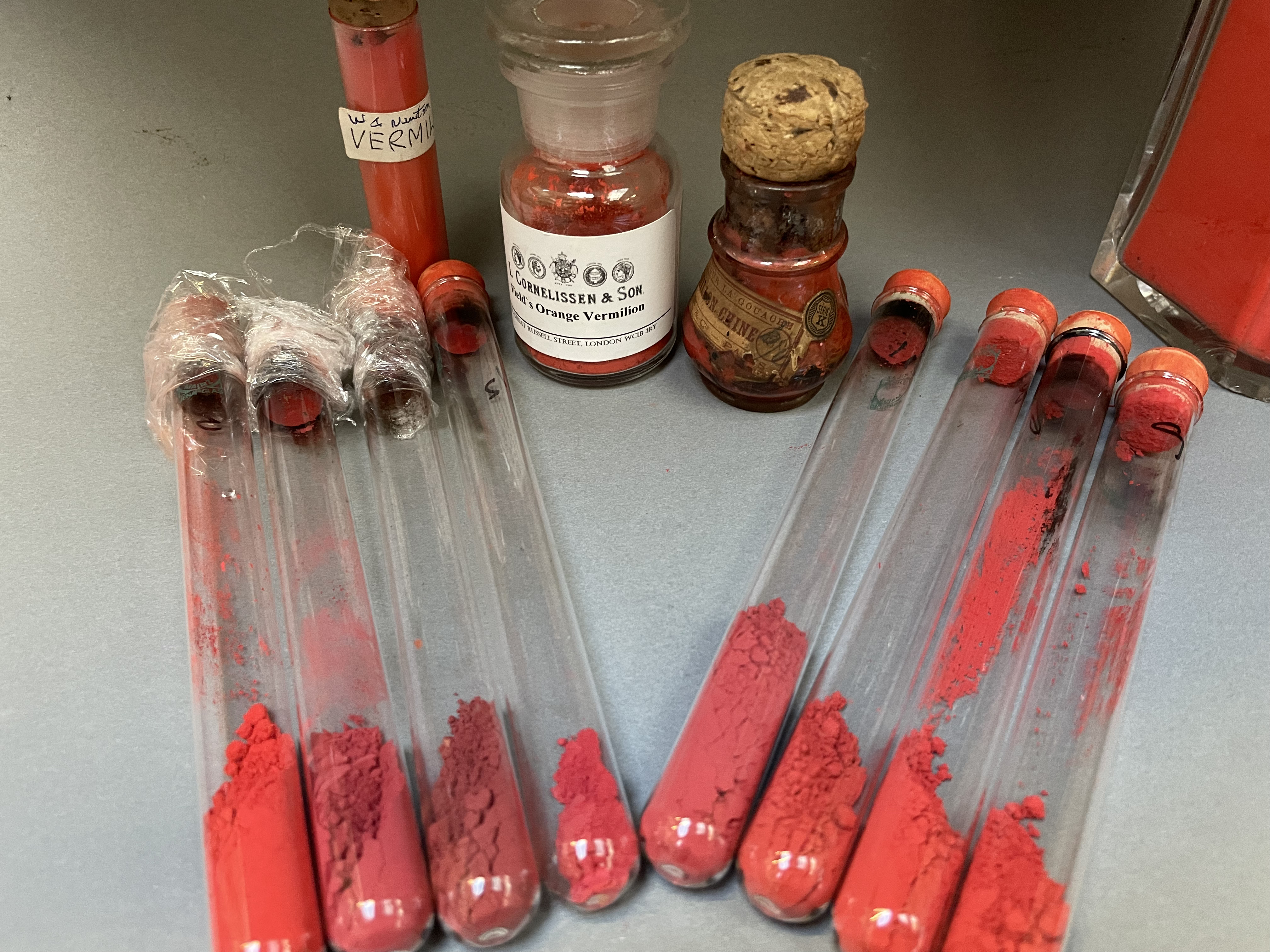
Cinnabar and Vermilion are so alike a material that they are hard to tell apart in an artwork. Yet, the former is naturally found in nature, and the latter is man-made. So, I get it, Vermillion is synthetic. Yet ochres, which men have burned since the Pleistocene, remain natural in their burnt versions. What’s the difference? Complexity of process? Combination of two ingredients? Are iron oxides more ‘natural’ than mercury and sulphur, then? They were/are often mined in the least ‘natural’ way possible. (Today’s pigment foragers usually approach the land with respect, but sadly the same cannot be said of most industrial excavation/production sites.) Ultimately, calling one or the other synthetic seems rather arbitrary.
Also, let’s go back to our art-chemists, as I like to call these gentle wo-men (yes, there are a few famous ladies), who poured over the mysteries of Matter and experimented around their fires, and compare them to a factory/lab producing kilos of pigments every day, entirely through chemical combinations. Is there no difference there, too? Surely there must be as, in today’s world, pigments have mostly become a commodity like any other. 10 million tonnes were sold worldwide in 2017, 1% of total global production ends up in an artist’s tube, pastel or pencil, 44% in other paints and coatings, and 95% of that production is Titanium White (in which, of course, you add some pigment dispersions in the hardware store to turn it into… Heart’s Desire, Autumn Mist, Cardigan Green or Living Coral… in short, a myriad of hues with exotic colour names, but not one mention of a known pigment there.) Carbon Black seems to have an even weirder destiny as 65% of the production of that lovely black one ends up… in tyres. Apparently, we like our tyres black. I suppose it goes better with your red Ferrari than a greyish, nondescript hue but… really?
You might not agree or perceive these differences, but to me, they are significant. I feel we’re talking about four different things, or pigment states perhaps even, and so I would like to suggest that pigments in their natural environment, indeed keep their “natural” label or maybe the more interesting name Tilke Elkins gives them: “wild pigments.” Could then pigments of natural origins processed in simple operations such as collecting, washing, levigating, sedimentation separating, drying, etc., be called “processed natural pigments”, perhaps? Could pigments requiring more sophisticated processes and more than one ingredient be called “art-ificial?” After all, there is quite an art in producing these. (Indeed, during the Song dynasty (960 to 1279), dandingpai, a word combining Cinnabar and crucible, i.e. Vermillion, became the Chinese term for alchemy.) And, finally, when made entirely in a lab, the produce of pure chemistry, could those pigments be called “synthetic”?
Will I convince anyone to add two categories? Probably not. But that doesn’t matter as I now think of them thus and not only because it’s perhaps more precise to do so, but because I find it more reverent to do so… and that’s my choice. (Plus, no one really needs these categories, except perhaps those that don’t agree about them!)
Jump to the next section of the book by clicking here
Alternatively click on the Table of Contents to browse the sections.
You can also subscribe to my blog at the bottom of this page,
and you’ll receive Hues in Tubes in your inbox… as it gets published!
Discover more from in bed with mona lisa
Subscribe to get the latest posts sent to your email.
 in bed with mona lisa
One Comment Add yours