WHICH?
Pigment Characteristics
What makes a good paint is very subjective. It has to please first the colourman making it. Secondly, the artist using it. It’s a bit like food… the chef might like it, and the client not. Or the client might find it perfectly delicious while the chef is, in fact, a bit disappointed with his dish that day! So, apart from ingredients being of first-class quality (in fine art paints), the rest is pretty much left to everyone’s appreciation. This is why it’s a good thing there are so many different companies, as they don’t really compete with each other. You wouldn’t want to go to the same restaurant all the time, would you?
When I began stocking a new range of oil paints, I was confident of offering a high-quality product. But one of my first clients returned a week later, horrified at the grittiness of the paint he’d bought. Not understanding much yet of anything then, I was truly devastated and lost for words to defend my new baby! I now know a bit more. Sure, his previous brand was not like that, but that didn’t imply that this one was no good. It simply was… different. (And, it goes without saying, he was 100% entitled not to like it.)

I pursued an amusing project for the mid-term show of my MA on pigments, reproducing in papier-mâché a plausible particle shape/size—for each of the 88 art pigments I was working with that year—and installing these into a 3D colour space. They needed obviously to be hugely enlarged versions of themselves as I wanted, both for my own enlightenment and that of those visiting the exhibition, to ‘show’ the invisible, offering visitors even perhaps an epiphany on how size and shape could alter not only the hue but also the transparency/opacity, sheen, etc. of Pigment. (In truth, I think the installation only managed to baffle everyone, but I was happy with the exercise.)
First, I had to determine a plausible shape/size. Fatally attracted to one another, pigments tend to cluster, and what you see when you peer into a jar of them is, in fact, tiny bundles of them, not single particles (these flocculations being precisely the paintmaker’s nightmare). Books helped (my Pigment Compendium bible1, which reproduces most of them under the microscope, was most handy.) Still, I was left with twenty un-‘identified’ pigments and requested the help of the school’s lab/microscope. It was a divine day, so very unusual. My first three slides were a total failure! Despite putting the smallest amount of pigment, it was still far too much, and they were truly unreadable. When I finally succeeded, my reward was unexpected enchantment. Each pigment an unknown planet. Each a different colour (sometimes quite different from expectations). Each a world in itself. I got so lost in contemplation that by the end of the day, I couldn’t have said if I’d spend the day looking through a microscope or… a telescope! For quite a few of them, magnified forty times was enough to see the particles. For others, apparently, a hundred fold would have been needed as these were more like dust than individual stars!

Secondly, I had to make the paint with which I would paint my papier-mâché particles. I needed it for other projects, too, but turning 88 pigments into paint, even on a small scale, is a big job. However, nothing I knew could have prepared me for the infinite variations of ‘feel’ these guys have. I took notes, and some are amusing, as images often popped into my head of… my grandmother’s friends who used too much foundation powder (and who I hated kissing), of the grit and sound of nail files, of puffs of smoke, the silkiness of ribbons. I could go on but let’s get to the point.
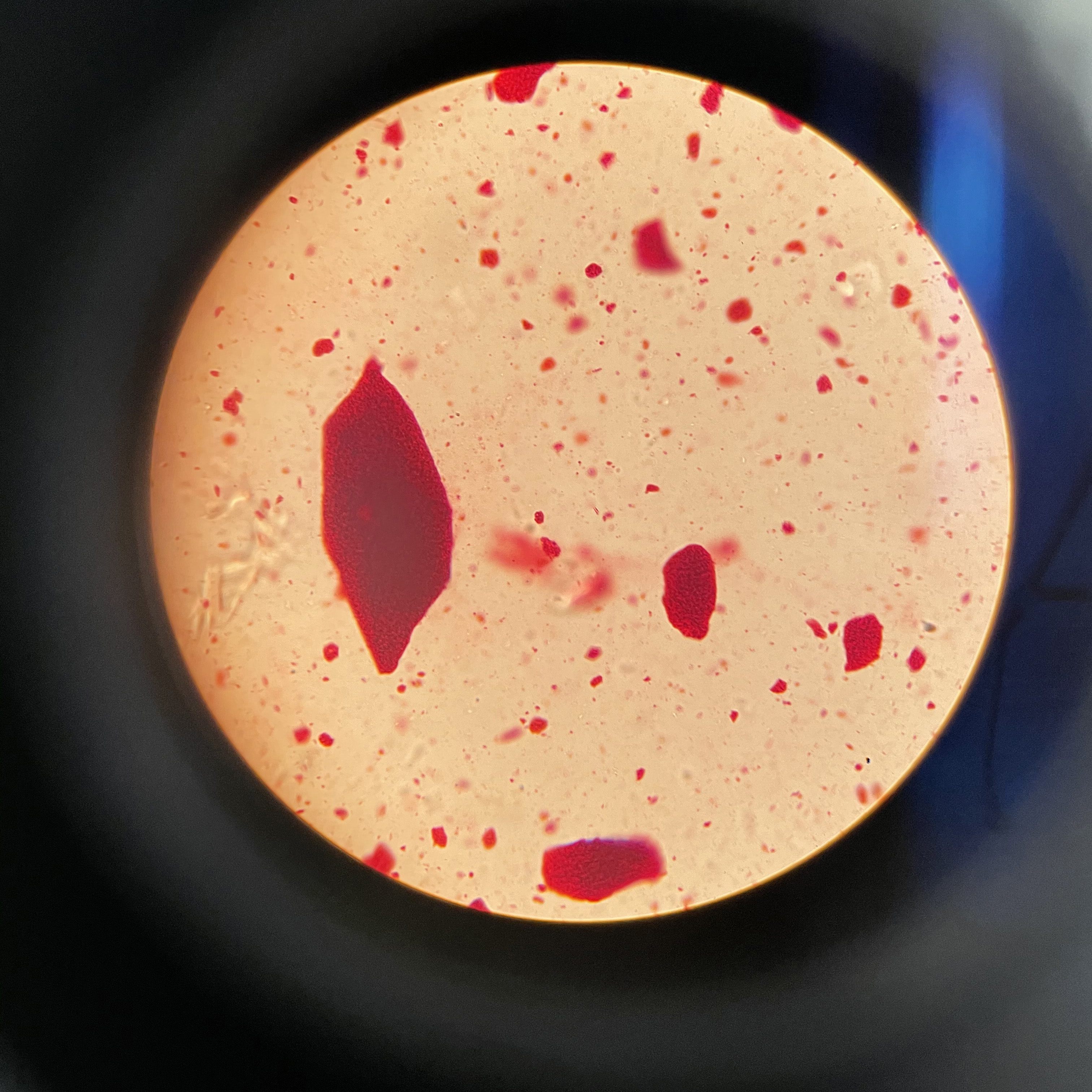
A paintmaker who is going to develop, once again, a colour to its Highest Emotional Resonance will also respect the beloved’s nature and accept these primary differences. In fact, he has chosen them for that very reason (not so different from how we choose our dancing partners, perhaps… look? shape? size?) And so his paints will end up with different textures created by how he mills his paint and the inherent nature of the pigments’ primary particles. As we’ve just understood, super-fine particles will be glossy and create a smooth paste. Most Modern organic pigments are in that category. Fine pigments, such as the Cadmiums, will do much the same, even if perhaps a tad less glossy. And, as you can see and imagine for yourselves when you get to particle sizes such as the ones in this genuine Alizarin Crimson, you might even feel them under your brush, however thoroughly the medium has coated the particles. And, yes, the paint, by and by, as particles grow, will turn semi-gloss or even matt.
Jump to the next section of the book by clicking here
Alternatively click on the Table of Contents to browse the sections.
You can also subscribe to my blog at the bottom of this page,
and you’ll receive Hues in Tubes in your inbox… as it gets published!
Additional information & references
- Eastaugh, N. et al. (2008) Pigment Compendium: A Dictionary and Optical Microscopy of Historical Pigments. (Volumes 1 and 2) London: Butterworth-Heinemann ↩︎
Discover more from in bed with mona lisa
Subscribe to get the latest posts sent to your email.
 in bed with mona lisa
Mesmerizing read!
Oh thank you… Indeed, these pigments are truly mesmerising!