HOW?
I feel like admitting right now that, although I researched this HOW? section as thoroughly as I did my whole book, I personally am no pigment or paintmaker… Yes, of course, I’ve tried my hand at both, but compared to some out there who have made that, if not their whole life, at least a steady ritual and/or practice, I feel somewhat embarrassed to even pretend I have the required knowledge to give you instructions. Please consider what follows as starting points only (it’s also often far more complex than I can develop here), and do not hesitate to consult the professionals mentioned in the Notes if you are serious about learning. Their books, videos and/or online courses, from having done or read them, I can personally highly recommend.

To Make Various Sorts of Blacks
First, there is a black derived from soft black stone.
It is a fat color; not hard at heart, a stone unctioned.
Then there is a black which is made from vine twigs.
Twigs which choose to abide on the true vine
offering up their bodies at the last to be burned,
then quenched and worked up, they can live again
as twig of the vine black; not a fat, more of a lean
color favored alike by vinedressers and artists.
There is also the black that’s made from burnt shells.
Markers of Atlantic’s graves.
Black of scorched earth, of torched stones of peach;
twisted trees that bore strange fruit.
And then there is the black that is the source of light
from a lamp full of oil such as any thoughtful guest
waiting for bride and groom who cometh will have.
A lamp you light and place underneath—not a bushel—
but a good clean everyday dish that is fit for baking.
Now bring the little flame of the lamp up to the under-
surface of the earthenware dish (say a distance of two
or three fingers away) and the smoke which emits
from that small flame will struggle up to strike at clay.
Strike till it crowds and collects in a mess or a mass.
Now wait; wait a while please, before you sweep this
olor—now sable velvet soot—off onto any old paper
or consign it to shadows, outlines and backgrounds.
Observe: it does not need to be worked up nor ground;
it is just perfect as it is. Refill the lamp, Cennino says,
As many times as the flame burns low, refill it.
Lorna Goodison1
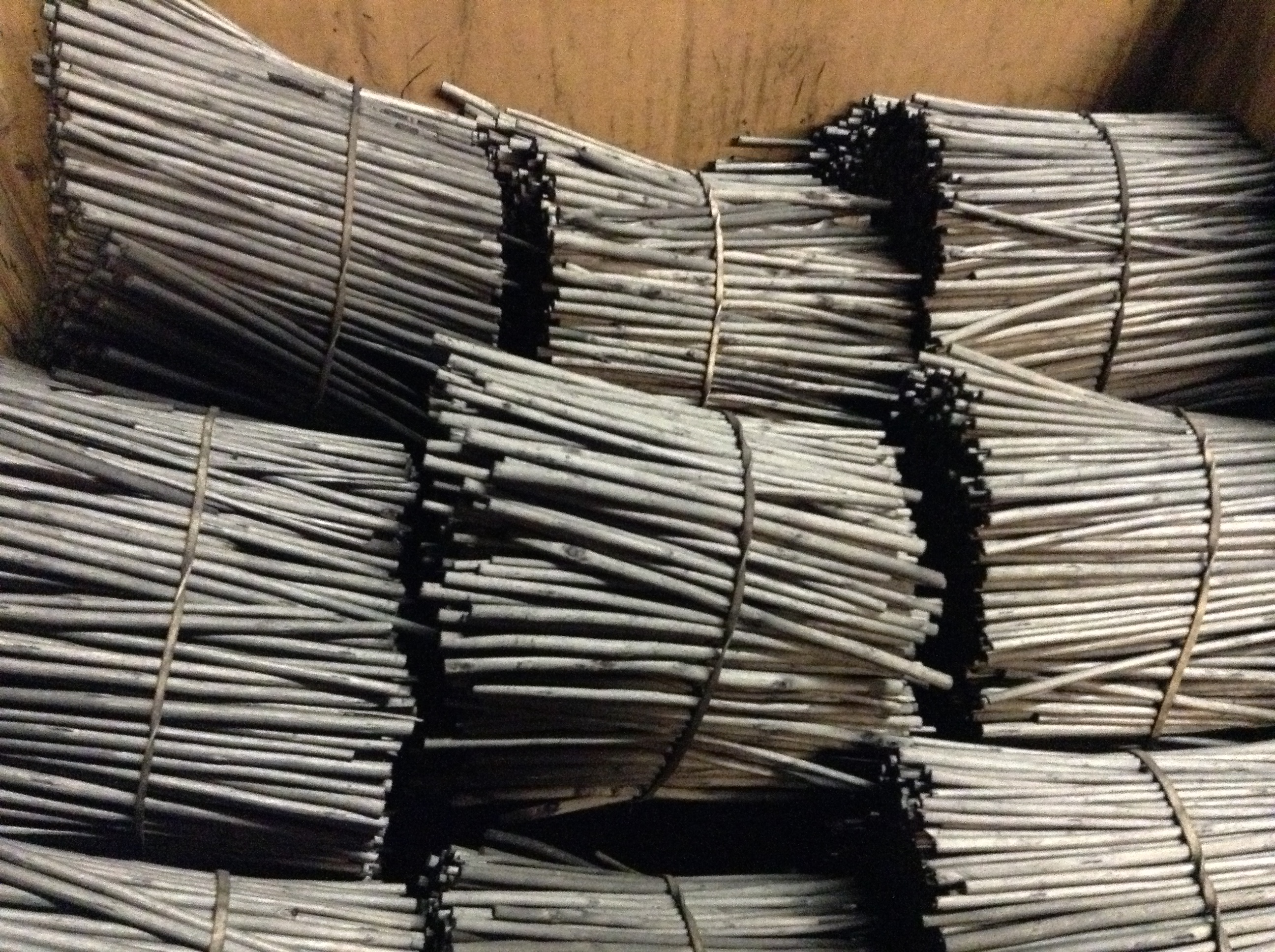
Yes! Some pigments are as easy to make as putting some twigs in a metal box and throwing it in your fireplace, relaxing by the oil lamp, pulling out the old guitar, retelling a worn tale to your folks or reciting above poem… going to sleep and, without further ado, you will find perfect charcoal sticks in your box and sooty Lamp Black in the morning! (That’s the easy ones.)
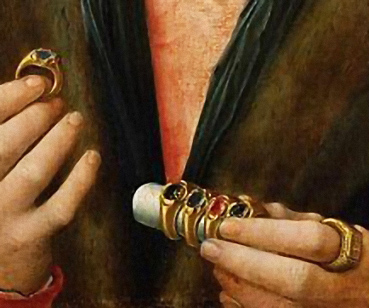
The next option in pigment making would be the mineral pigments… To my knowledge, and although Andy Warhol and a few other artists have used genuine diamond dust in their works, no ruby or emerald was ever crushed to give us colour—even if you find both names on tubes. (Nor any other precious gem, for that matter, as these are probably far more valuable to us as a big rock than a little pile of nanoparticles!) Other, cheaper minerals are turned into paint, of course. A company like Daniel Smith even has an in-house geologist ready to fly to any vein and test it for its suitability as a paint pigment. A few of these mineral pigments do end up also in their oil colours, but watercolour binder seems to be their favourite environment, one in which they can best display their gorgeous sparkles and granulations. In their Primatek range, all tubes have seductive names reflecting their mineral content, such as Sleeping Beauty Turquoise, Minnesota Pipestone, Amethyst genuine, Burnt Tiger’s Eye Genuine, etc.
You might wonder why so few minerals and semi-precious stones are used as paint pigments, but teasing out a colour from a raw material is not as obvious as it looks. Hear what Heidi Gustafson, ore whisperer by profession (yes that sort of exists!), shares about that option: “Many brightly colored rocks are ‘color experiences’ as forms, but when crushed up into powder, the color, materially, goes missing. The powder appears white, greyish, or clear, as the elemental structure of the rock is largely crystalline, transparent, silica (SiO2).” A fact that has produced something of a storm in a teacup when geologist and co-author of The Pigment Compendium, Dr Ruth Siddall, analysed Daniel Smith’s Primatek paint range… virtually no amethyst, jadeite, sugilite, etc. in their eponymous paints but predominantly modern synthetic pigments! (This was a disappointing revelation as this is not how they market them, and they are expensive!!2)
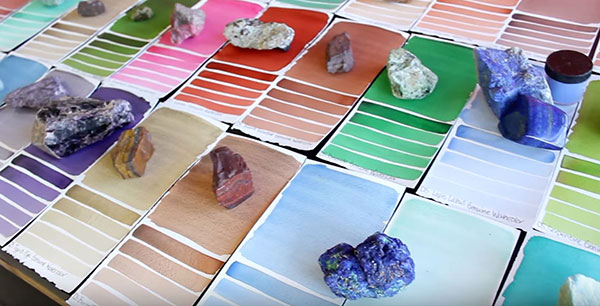
So, before you go and break the piggybank to buy some precious or semi-precious rocks, I think you might want to concentrate on Ochres and other Earths (just as precious, if less valued in our world.)3
Where will you find some? How do you know which rocks to grind?4 I could give you this poetic answer from a Navajo oral history of Spider Woman, sacred weaver and protector: “From the east I get white, from the south I get blue, from the west I get yellow, and from the north I get black. The designs come from the earth.” but it might not be entirely practical! In fact, on your next walks, simply observe (you needn’t even leave your city) and soon you should notice a colourful streak or waste stream there, an interesting roadcut here… even if some spots are far richer than others, of course.

You’ll probably be attracted to the most colourful ones and, if soft, you might have a good chance of turning them into a pigment (the harder they are, as colourful as they might be, not only the harder they will be to crush but also the less likely they will make a good pigment). However, as Heidi Gustafson also warns, “Not every stone wants to become a pigment. Not every pigment wants to become paint. A good few in this case, really wanted to be admired, just held by retinal arms. Ones that do say “Expose me!” leap right into the mortar, and there’s a deep pleasure in cracking into them, like yolk or seed.” I would suggest you read her beautiful book, Book of Earth, but meanwhile this article of hers, Dust to Dust, is must.5

And, yes, turning ochres or other earths into art pigments is a simple process. First crush your rock… you will need a good pestle and mortar for this stage and a mask too, so as not to breathe in dust. (May I suggest you will enjoy looking at this video6, in which Catalina Christensen will give you a few tricks, including using an old sock, which will reduce this issue.) You can sieve as you crush to obtain a finer powder, but the levigation process is far more effective in separating the grains of sand and other impurities from the particles of colouring matter. This consists of ‘washing’ the raw material in water, then, after letting it settle a bit, you’ll notice that the pigment floats while the impurities sink, so now carefully transfer the coloured liquid to another container and… repeat. After a few times, when the water is finally clear, it’s the pigment that will settle at the bottom of the container. Drain one last time, and leave the ochre to dry. Later, you can crush that cake and turn it into paint by adding the medium of your choice. You might also be quite disappointed with your result, as not much iron oxide is needed to colour a rock, and all these efforts to turn this intense red into a pale pink powder might seem quite disproportionate but… what can I say? Pink is lovely too, perhaps?
Cennino Cennini warns that levigating alone—“the process of grinding an insoluble substance to a fine powder, while wet” and, yes, I know this definition might come up as a bit of a surprise because (and maybe because it reminds us of levitating?) the word is so often incorrectly used for the next process, sedimentation separating—might definitely test your patience and your arm… shoulder, elbow, wrist and all! “Then take some of the black (or of any other colour), about the size of a walnut, and put it on the slab, and with that stone which you hold in your hand break the pigment into small pieces. Put some clean water, either from a river, a fountain, or a well, to the colour, and grind it well for the space of half-an-hour, or an hour, or as long as you please; but know, that if you were to grind it for a year, so much the blacker and better would be the colour.”
I don’t suggest a whole year! Nevertheless, this is a slow process, but while this arm of yours is put to severe contribution, you could muse about the connection to our so, so long-gone ancestors who, in the Blombos caves, were already “[…] involved (in) the rubbing of pieces of ochre on quartzite slabs to produce a fine red powder and combining these [ochre chips] with heated crushed, mammal-bone, charcoal, stone chips and a liquid, then introduced it into the abalone shells and gently stirred.”7
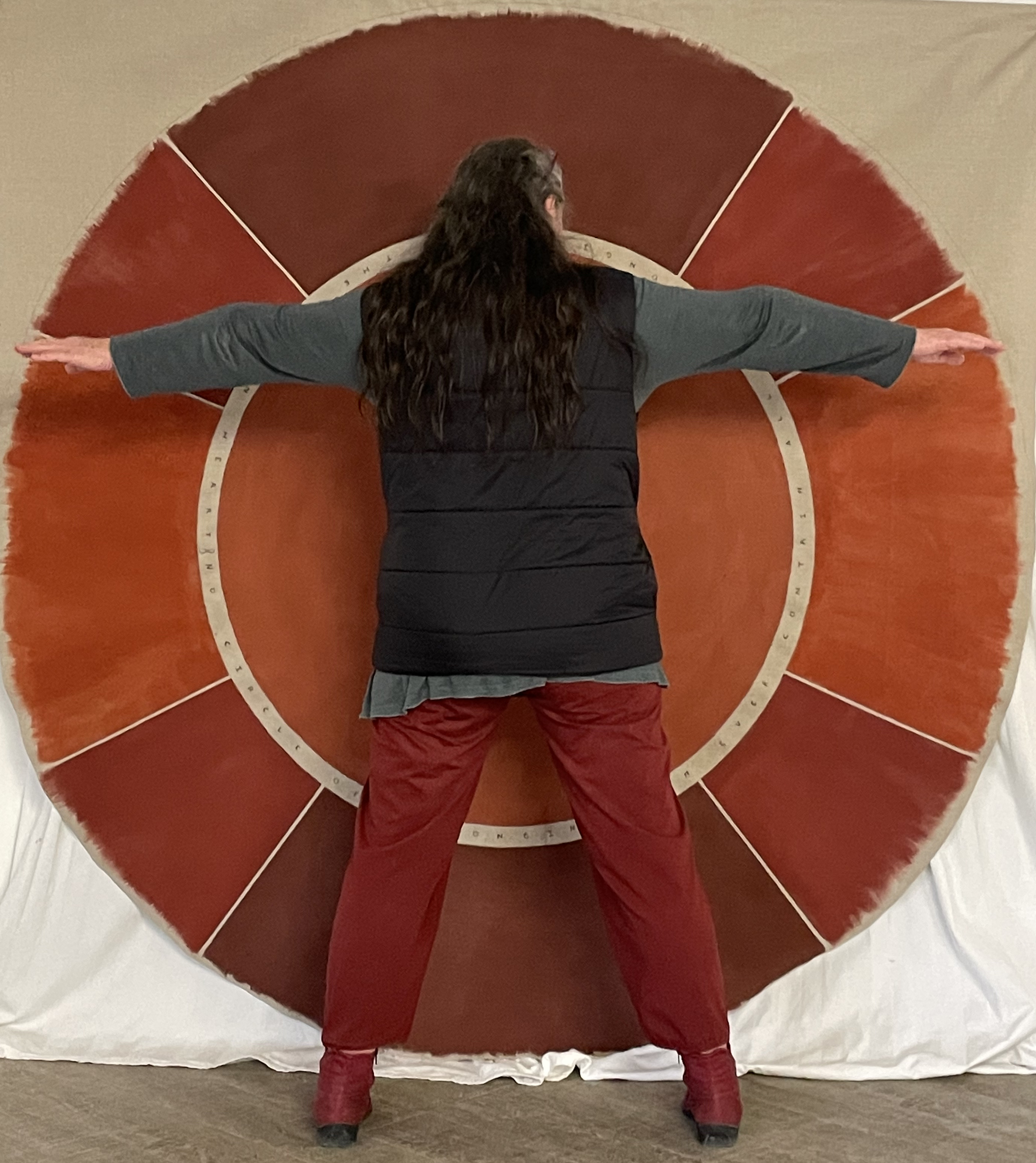
The simplicity of this has recently attracted many artists who often wish to use more ‘natural’ pigments, while also connecting with the land, the place where they find the colourful bounty. Lucy Mayes’ story is both similar and quite different. She’s a Londoner, an urban girl and —although working at Cornelissen and selling bags of pigments daily— she hadn’t, at first, seen a connection there for herself… until one day and I will let her tell the story of how it all started, as it’s pretty magical… https://www.youtube.com/watch?v=2qFMKo33bl4
Soon enough, though, being the curious lad she is, she began picking up flowers on sidewalks, oak galls or barks from trees, and began making ink and lake pigments too. She now produces and sells her handmade wares and has become quite the expert. (If you are truly interested in the process, I cannot recommend highly enough to take her online course.)
On a final note… If you feel inclined to walk in the footsteps of those who forage Earth pigments today, perhaps to enhance your connection with the land you live in—including your urban landscape—do so responsibly. Removing land from its place is no neutral act, so do so with reverence, with kindness. Be not extractivist but relational. It is a deep and subtle experience, a peaceful process. Be open to receiving… “There’s a devotional slowing down, an entering of dreamtime, not unlike falling in love, that’s involved in pigment foraging.” Heidi Gustafson even suggests. (And, knowing her, I believe she would include all the steps of collecting, washing, levigating, sedimentation separating, drying, etc., in that devotional approach.)

OK, so making a lake pigment or an ink from natural plants, barks, roots, etc., is, to begin with, the same as making a dye but, it’s totally impossible, here, to go into all the dye recipes or those for ink making, so go to the note below8 where I suggest a few fab places to begin your research.)
If you want to make an ink, you’ll turn your coloured liquid straight into an art material, with the addition of a binder (and sometimes a few extra steps.) If you want to use it to make paint, you’ll first need to turn it into a pigment and creating a basic lake pigment from your coloured liquid can range from easy to complex, depending on your starting point. Here’s the easy approach, which will mostly work.

Not all dyes will work with alum but, in this recipe, you’ll need alum (potassium aluminium sulphate) used in fabric dyeing too (so that’s a good place to look for it, if your art shop doesn’t offer it.) Then, to turn it insoluble, you’ll also need an alkali. Chalk, potash or washing soda work just fine.

First, pour your dyestuff through a coffee filter to remove all possible bits of plant matter, etc. Dissolve your alum in water over a stove and then pour it into the same jar (jam jars are great, as they can withstand the heat). You might notice a change of colour already, or… you might not (not yet anyway!) Now, repeat with the alkali: dissolve it in water on the stove, then pour into the jar.
That’s when the fun begins! Fizz, fizz, fizz and something of a mini nuclear explosion (the correct word is ‘precipitating’ and why you will want to make small batchs and not overfill your jar.) As ever and always, it’s all a bit of a trial and error and the quantity of alum and alkali will differ with each dye. You can always add some, so be cautious at first. Go pour yourself a glass of wine and give yourself a tap on the back, as step two is over and your crazy jar needs to settle.

When the precipitation has sunk to the bottom of the jar, it’s pretty much the same as with a mineral pigment. You’ll need to wash it in successive water baths until the water is clear, and then let it dry. Pouring it through a cloth or another paper filter is a good way to do this. To expedite the process, use a few filters so the draining and drying don’t take ages, but it might still take a few days. (Meanwhile, think about the artwork you will soon make!)

Finally, crush your dried pigment cake in a mortar, store it in the cutest jar you have, or use it immediately with the binder of your choice. (Paintmaking coming in the next section.)


c.1st/2nd century AD, Musée de la Romanité, Nimes

Jump to the next section of the book by clicking here
Alternatively click on the Table of Contents to browse the sections.
You can also subscribe to my blog at the bottom of this page,
and you’ll receive Hues in Tubes in your inbox… as it gets published!
Additional information and references
- Lorna Goodison’s To Make Various Sorts of Black (Winter 2013 issue of U.S.A.Hudson Review, [Online]. [Accessed 2 March 2025] https://hudsonreview.com/authors/lorna-goodison/) is a poem referencing Cennino Cennini, Renaissance artist and author, in his chapter XXXVII of Il Libro dell’Arte (1437), translated as The Craftsman’s Handbook by Thompson, D.V. Dover, New York ↩︎
- Amusingly, one of the three reasons that made Dr Siddall suspicious is how cheap they were! Some of the minerals in the range are super rare and dear. She also found them too coloured, darker than the mineral itself, especially when ground, and the colours often didn’t look ‘right’ to her. Her findings, using a polarising microscope, were depressing: “Genuine Amazonite” was 90% Phthalo green, Jadeite, too, in “Genuine Amethyst”, Dioxazine was the major pigment present, in Rhodonite an organic red, in Purpurite Manganese Violet, and Sugilite and Fuchsite were dominated by synthetic, oxide-coated micas… She wrote to Daniel Smith and received the most imprecise and condescending answer: “[…] The label says Genuine. It IS genuine. It does not say 100% mineral only. This is NOT possible. […] Minerals are NOT consistent, it is their nature. This is a manufacturing process that is private and will not be shared. It DOES NOT Take away that every colour is made with real mineral.” Sure but… how much of it! (If interested, read the whole conversation on her Instagram #worldpigmentday 19/25 April 2021) ↩︎
- Ochres are also Earth pigments but distinct in their chemical composition. For example, Siennas and Umbers are not considered ochres as they contain manganese oxides not present in ochres. But as easy as saying this, a precise definition of an ochre is still elusive and subject to much debate between specialists. I’ll give you this one from The Pigment Compendium: “Geologically, we can define ochres as earthy, metal oxide- or metal oxide hydroxide-rich deposits which form in the surface or near-surface environment. […] Naturally occurring ochres are by definition impure deposits containing a mixture of mineral components, commonly quartz, carbonate, clays and/or micas as well as metal sulphides. They are encountered as primary ochres, lying in close association with ore bodies or as secondary ochres subsequently concentrated in sediments and soils. Commonly, these are soft and friable and therefore easily excavated and processed.” ↩︎
- And, btw, what’s the difference between a rock and a mineral? Rocks are made up of a variety of minerals and are named after them. For example, granite is not granite unless it contains mica, feldspar and quartz AND I would not suggest trying to grind it… far too hard! ↩︎
- Gustafson, H. (2019) Dust to Dust: A Geology of Color. [Accessed 12 November 2021] Available at: https://thesideview.co/articles/dust-to-dust ↩︎
- https://www.youtube.com/watch?v=YnT7v0a0jSA ↩︎
- https://gizmodo.com/100-000-year-old-art-kit-found-in-south-africa-5849677 ↩︎
- There are others but I can recommend these books specifically about pigment making and paint making
Delamare, F. ( 2000) Colour: Making and Using Dyes and Pigments. London: Thames and Hudson
Gustafson, H. (2023) Book of Earth: A Guide to Ochre, Pigment, and Raw Colour. Abrams, New York, NY, U.S.A.
Kremer Pigmente Recipe Book (2023), is a self-published paintmaking recipe book by the German Pigment company Kremer, which you can order on their website: https://www.kremer-pigmente.com/en/shop/books-color-charts/english-books/992101-kremer-pigmente-recipe-book.html
For those not too far from Vancouver and keen on natural dyes, The Maiwa School of Textiles offers some great courses. But for those ultra keen, they also offer an online course in: Natural Dyes: Alchemy, Chemistry, Craft by Tim McLaughline &Charllotte Kwon (fascinating but arduous!)
Logan, J. (2018) Make Ink: A Forager’s Guide to Natural Inkmaking. Abrams, New York, NY, U.S.A.
MacDonald, L. In Pursuit of Color, From Fungi to Fossil Fuels: Uncovering the Origins of the World’s Most Famous Dyes, Atelier Éditions & D.A.P.
Mayes, L. (2025) The Natural Pigment Handbook, A Maker’s Guide to the Art, Stories and Recipes for Creating Paint. David & Charles, Exeter, UK
Mayes, L. The Craft of Pigment Making , An Online Foundation Course by London Pigment. Available at https://londonpigment.com/products/the-craft-of-pigment-making-online-foundation-course
Price, M. (2017) Renaissance Mysteries: Volume I: Natural Colour. Michael Price Inc., New York, NY, U.S.A.
Ross, C. (2023) Found and Ground: A practical guide to making your own foraged paints. Search Press, Tunbridge Wells, UK
Webster, S. (2012) Earthen Pigments: Hand-Gathering Natural Colours in Art. Schiffer Publishing Ltd, Atglen, PA, U.S.A.
↩︎

Photo: Lucy Mayes in the natural ochre site of Roussillon. © Sabine Amoore Pinon
Discover more from in bed with mona lisa
Subscribe to get the latest posts sent to your email.
 in bed with mona lisa
One Comment Add yours