WHYEVER?
Hues in Tubes… and how they made a name for themselves
Should we first find out first how the basic hues got their names? Let’s, I think it might be fun! Plus, red, blue, green and yellow do appear on tubes. Not by themselves, but usually preceded by a family name such as Cadmium or Cobalt… in truth, how else could we tell these members of the same family apart?

In languages’ universal order of appearance, if studies are anything to go by1, colour words seem to have appeared in this order: black and white, or at least some sort of distinction between dark (cold) and light (warm), which became more defined later as black and white, then red. Newborns, too, can only see varying contrasts of black and white, and the primary colour they are able to distinguish in the first weeks of their life is red. Whether there is more than coincidence to be found in this parallel is for you to decide, I have never seen the two facts mentioned alongside one another but the synchronicity amuses me. Some dialects stop there, their users seeing no need to further colour code their environments. If they do, yellow comes next, then green. Blue in English, and most modern European languages, emerged from words meaning green or, more frequently, from black. Violet and orange trail way behind all of the above, and as for magenta… now that’s another story.

That colour is the zip at the back of the colour wheel, if you will. My analogy referring to where infrareds and ultraviolets would merge if, instead of a band, you chose to see a circle. But can you see it anywhere on the spectrum? No, and that’s because, contrary to all other visible colours with a specific wavelength, magenta doesn’t have one, so it actually does not ‘exist’ on the light spectrum. Our brain creates it, though, to fill in that space coherently, and having only RGB, i.e. red, green, and blue, cones to translate all colour information, as always, it interprets what it sees. For example, when blue and yellow mix, it averages a green, as we all know. However, when red and purple blend, it should also average green, the wavelength halfway between them. But the brain doesn’t like that result, which is obviously confusing as we’ve already got a green. So with the radically different red and purple at opposite ends of the spectrum, our clever brain “invents” magenta instead, the complementary colour to green and the colour of the afterimage you would get after staring at green.2 More than all others, and maybe (I would like to believe) because it’s left entirely to our imagination, magenta is a truly imprecise colour. If you Google it, you see the range of variations on the theme from the Magenta in CMYK to a Magenta coming out of a paint tube… quite crazy! (Still, I’ll stick to my guns; nothing like Rose Madder!)
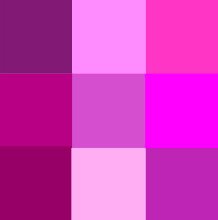
The absolute late-comer on the hue scene, magenta is also the only one named so oddly after a battleground when the etymological origins of our primary hues are more ancient, descriptive and down to earth. Green, for example, relates to the Old English grēne, to grow. Grey comes probably from the Old French grège raw, unbleached. White, from the Old English hwit, light, used to refer to lightness as well as to the hue it describes, and Teal was the name, in 14th century England, of a small freshwater duck, the feathers of which you can easily visualise in striking greenish-blue! Orange, too, is a recent one… the fruit came first (in English) around the 13th century, but the usage of it as a colour would have to wait another two.
On the other hand, it’s somewhat hard to believe that yellow, the word, comes from the Old English geolu, geolwe—sharing with gold the proto-Indo-European root, ghel, meaning “to shine.” But perhaps even harder to believe is that black, from the Old English blæc, and bhleg has a proto-Indo-European root, meaning… “to burn, gleam, shine, flash”! As for red’s proto-Indo-European root rēd to mean “scrape, scratch, gnaw”, surely this is even weirder than a shining black!
Along the timeline, there is also the case of the cart and the bull swapping places in the colour scarlet, which used to mean, in Latin, a fine cloth. In the 13th /14th century, the expensive scarlatta became synonymous with orangey-red cloths produced when dyed in kermes, and then, quite logically, when scarlet took over the paint world, medieval manuscript illustrators began using the name to describe their kermes lake.
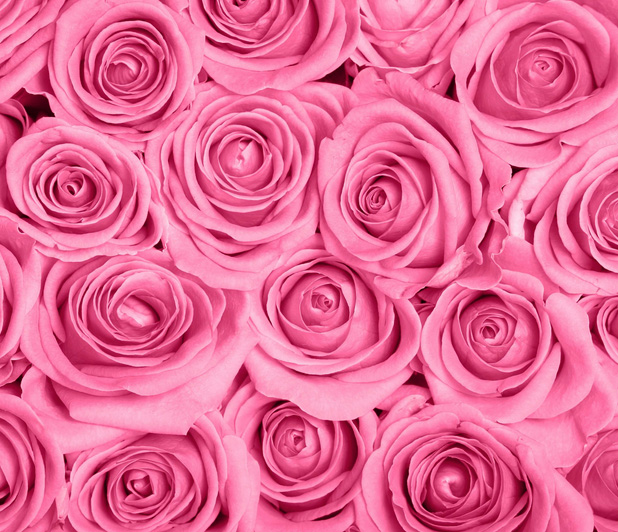
Another hue, closely related to lakes, is pink, or pinke as it was spelt then, back in the 17th century. It has a curious story to tell as the term was used only for lake colours, most of them… yellow! English pinke, Italian pinke, Dutch or Brown pinke all referred to yellow lakes produced from buckthorn berries, quercitron bark or weld, and there is no known explanation as to why yellow blushed into a rose in the 18th century, except perhaps because the word comes from the German pinkeln which translates as “to piss or make water”… quite frankly, even if you close your eyes, not sure you see “la vie en rose!”
Were you to google “What is the difference between violet and purple?” you would find out most websites will first tell you that violet is a lighter shade than purple (really?), then go on to explain that violet is a ‘real’ colour, a scientifically labelled spectral colour, with a wavelength of 380nm to 450nm. This viola (named after the flower in Latin) sits in between blue and ultra-violet but should not do so on a palette! That colour, the colour of our mixtures of red and blue, should be called purple. A colour that “doesn’t exist”, as it’s “just a perceived color”, “just a subjective color” “just a mixture of two primary colors”, the same websites add, not without a measure of condescension for the colour purple I’m sure Alice Walker would have something to say about. (Paintmakers and pigment namers don’t seem to be in the least aware of that distinction as there are quite a few tubes of Egyptian Violet, Brilliant Violet, Provence Violet, all mixtures indeed but pretty dark and, of course, Cobalt, Ultramarine and Manganese seem to be always Violet while Dioxazine and Quinacridone can be labelled with either adjective depending on brands—all single pigments which, presumably, ‘exist’ in the material world and are just as real as porphura, the purple dye our sacrificed murex relented so we could make Tyrian Purple… Both are old words, but when did they come to mean or represent different hues? Do they? And who is the authority on these purple/violet divisions? As I would like a word then…

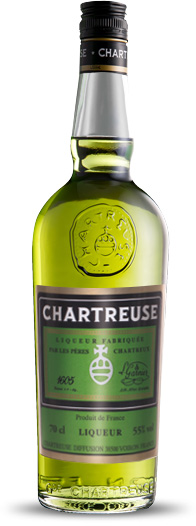
One for the road? OK. I’ll give you Chartreuse; how’s that for a name to describe an acid green-yellow? Don’t drink too much of it before you get behind the wheel, because with its 69% alcohol content… not a great idea. And yes, this colour gets its name from a medicinal tonic the Carthusian monks have been making in France for centuries in their quiet valley tucked in the Chartreuse mountains. The recipe was handed down to the Chartreux order in 1605 as a gift, but it took the monks over a century to do something about it, and then understand how to macerate, infuse and blend the 130 herbs of its composition into a perfect “Elixir of Long Life.” The medicine was tasty. People began drinking it for pleasure. The monks then modified the recipe somewhat to offer a milder version, and Green Chartreuse (still 55% alcohol, mind you) took off as a liqueur. Try it one day if you haven’t. Its taste is quite unique, its colour fab… can’t guarantee the bit about longevity, though!
Jump to the next section of the book by clicking here
Alternatively click on the Table of Contents to browse the sections.
You can also subscribe to my blog at the bottom of this page,
and you’ll receive Hues in Tubes in your inbox… as it gets published!
Additional information & references
- The oldest and most influential being: Berlin, B., Kay, P.: Basic Color Terms (1969). University of California Press, Berkeley ↩︎
- Do you want to understand more about that elusive magenta? Read the full article, available at: https://www.bbc.com/reel/video/p0f00wp9/magenta-the-colour-that-doesn-t-exist?ocid=ww.social.link.email ↩︎
Discover more from in bed with mona lisa
Subscribe to get the latest posts sent to your email.
 in bed with mona lisa
One Comment Add yours