WHYEVER?
Hues in Tubes… and how they made a name for themselves
Some paints are named after… someone who could be…
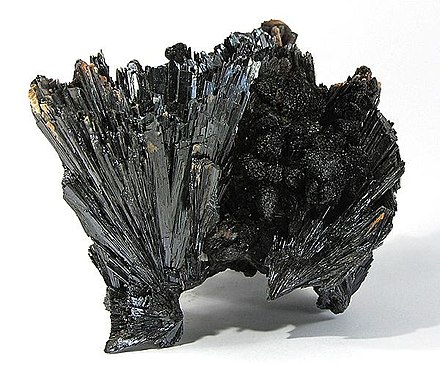
Ardent mineralogist and colour passionate too, he goes by the name of Goethe, and a yellowish-to-reddish-to-dark-brown or even black Earth pigment, Goethite, bears his name.1 However, one could argue that another pigment would have been much more appropriately called thus. To be precise, and it’s only a personal opinion, synthetic Ultramarine should have been named after him. First of all, because different names would have avoided ongoing confusion between the genuine and the synthetic one, and also because it was Goethe who first recorded how, in a little foundry in Sicily, he noticed and purchased some blue they were accidentally making there:
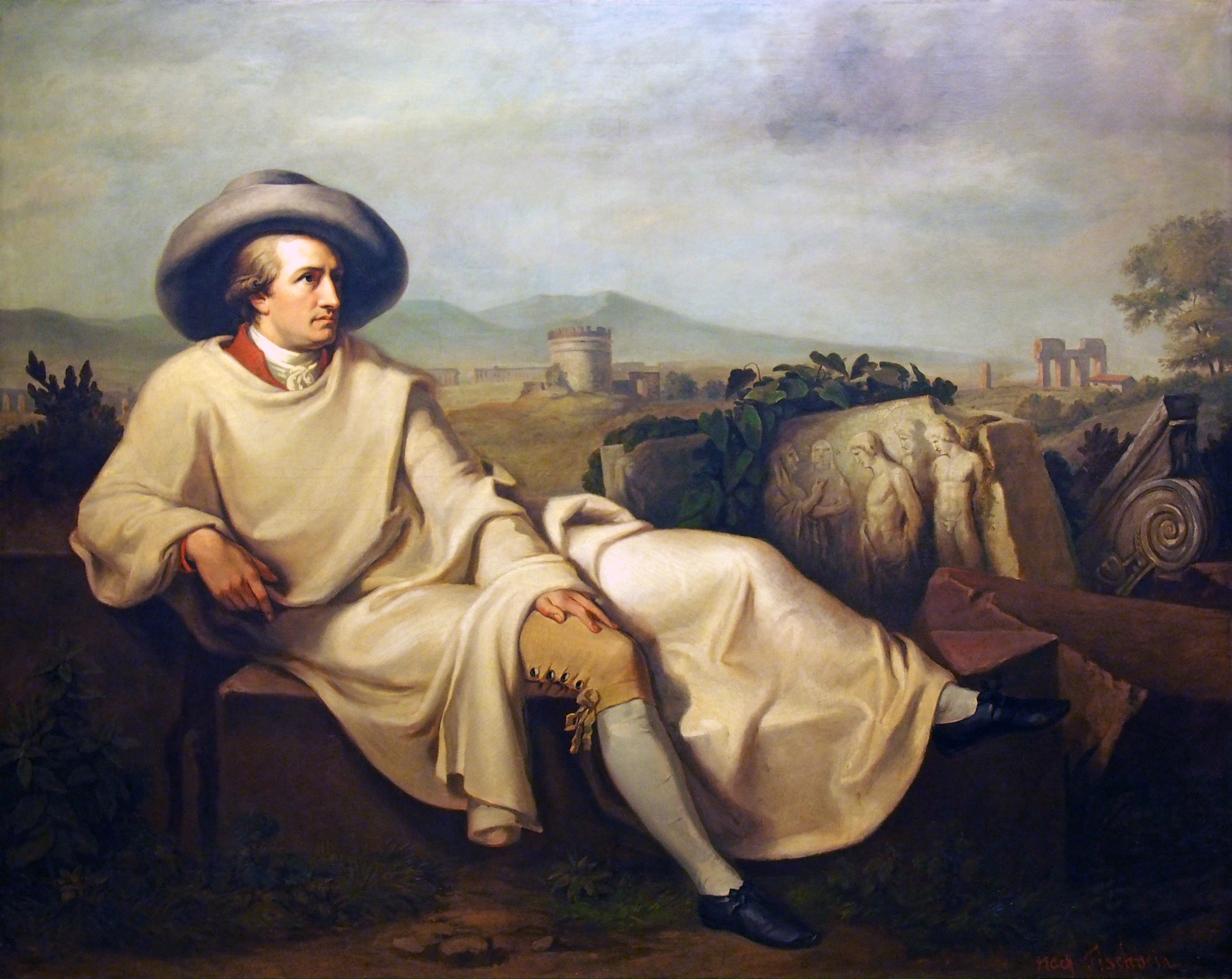
Johann Heinrich Wilhelm Tischbein, Goethe in the Roman Campagna, 1787. Stadel Museum, Frankfurt, Germany
“Palermo, April 13, 1787. Count Borck has very diligently worked before us in the mineralogy of Sicily, and (his) essay in quarto has been of great use to me; and, prepared by it, I was able to profit by my visit to the quarries, which formerly, when it was the custom to case the churches and altars with marble and agate, were more busily worked, though even now they are not idle. I purchased from them some specimens of the hard and soft stones; for it is thus that they usually designate the marble and agate, chiefly because a difference of price mainly depends on this difference of quality. But, besides these, they have still another for a material which is the produce of the fire of their kilns. In these after each burning, they find a sort of glassy flux, which in colour varies from the lightest to the darkest, and even blackest blue. These lumps are, like other stones, cut into thin lamina, and then pierced, according to the height of their colour and their purity, and are successfully employed, in the place of lapis lazuh, in the decoration of churches, altars, and sepulchral monuments.”2
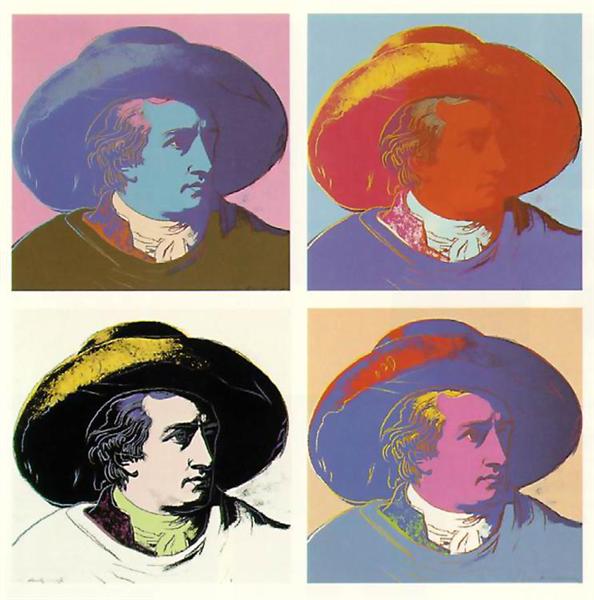
I quote this one in full to you, just for the pleasure. I can so see Goethe with his wide-rim hat (as Tischbein represented him and Warhol would, later too, in all colours) under the harsh sun of Sicily, enjoying the quiet life of the villages, the piazzas, its churches and altars, walking on the donkey paths, poking at stones, marvelling at some vein of ochre… True? Who knows? It’s only a visitation I share with you here.
As for an official artificial Ultramarine, and since Goethe didn’t fully understand the potential he was seeing, it would have to wait until 1828 when the mighty reward of six thousand francs from the Société d’Encouragement de l’Industrie Française prompted chemists to compete for it. Within weeks of each other, Jean-Baptiste Guimet understood how to combine and heat a number of elements (china clay, soda ash, coal, charcoal, silica and sulphur) to produce a cheap alternative to lapis and, too, a German professor, Christian Gottlob Gmelin, using a slightly different process. Are you surprised to hear the French Société gave the price to Guimet and the new pigment the name of French Ultramarine? Both went ahead and commercialised their discovery, however, but the German version simply ’stole’ the good old name of lapis: Oltromarino. Today French Ultramarine still exists on tubes and, perhaps still due to different processes, is a slightly redder blue, but I have not been able to find out if the difference in colour existed already back then.
Subscribe to my blog at the bottom of this page,
and you’ll receive the next section of Hues in Tubes in your inbox!
Alternatively, click on the Table of Contents to browse the sections.
Additional information and references
- “Its main modern use is as iron ore, being referred to as brown iron ore. Goethite is an important component of ochre pigments and has been heat-treated for use as a red pigment since Palaeolithic times.” [Online]. [Accessed 2 March 2025]. Available at: https://en.wikipedia.org/wiki/Goethite ↩︎
- The Works of J. W. von Goethe, Volume 12, Letters from Italy, Part VIII translated by Alexander James William Morrison. [Online]. [Accessed 2 March 2025]. Available at: https://en.wikisource.org/wiki/The_Works_of_J._W._von_Goethe/Volume_12/Letters_from_Italy/Part_VIII
↩︎
Discover more from in bed with mona lisa
Subscribe to get the latest posts sent to your email.
 in bed with mona lisa
One Comment Add yours