“Oil painting without media, or with only linseed oil and turpentine, is like going to a French restaurant to order boiled duck, no sauce. An appropriate medium does for oils what a French chef does to an otherwise bland and greasy dead bird, and the results, like Duck à l’Orange, are exquisite.”
Steven Saitzyk
ART HARDWARE, The Definitive Guide to Artists’ Materials
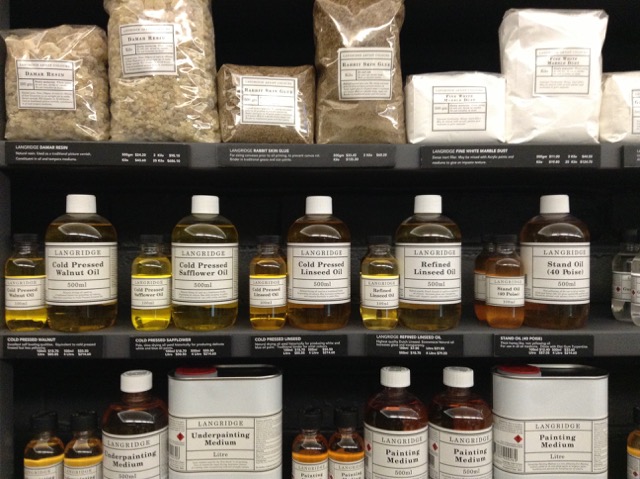
MEDIUMS
Less poetically said perhaps, oil mediums are used for changing the consistency of the paint, rendering it more convenient for brushing and applying, or more suitable for your particular technique, which may require paint that is thicker or thinner, faster or slower drying, more transparent or opaque.
Many students are not properly taught about mediums and go for the cheaper option of using turps (solvent), whether it be gum turps, artist’, citrus, or odourless products. However any overuse of these will denature the perfectly prepared, balanced, paint.
Turps, if used on its own, should be used quite sparingly. To overcome this problem, artists for many years have added varying proportions of linseed oil to turps turning it into a ‘medium’. You can make your own medium of course and, for those who do not want to make their own mixtures, ready-made mediums are available in all art stores. These will help you follow the “fat over lean” rule without difficulty and with consistent results. Depending on your style, you may or may not need all the mediums below but I find interesting knowing about them. It might give you ideas to experiment with and knowledge that will enhance your existing techniques.
(NB: ‘Fat’ and ‘lean’ should not be confused with ‘thick’ and ‘thin’. A lean paint can be very stiff and go on thickly while a fat paint may have so much oil in it that it goes on thinly.)
Depending on the company who produces them, painting mediums are sometimes named 1, 2, 3 4 or Underpainting, Painting and Glazing Medium, Lite, Fat… etc. but basically, apart from quality of course, most brands offer the follwing options (and often there is a choice of a low-toxicity solvent (odourless), too:
- A Underpainting medium to be used for the ‘first-sketch’ in painting. Low oil content for rapid drying, minimising chances of cracking when overpainting with full strength colours. A Stand Oil base is usually used and ensures non-yellowing of artwork but this lean medium contains usually the minimum Stand Oil to cross-link the medium and the oil paint, preventing the breakdown of the vehicle and ensuring permanency. Two thin coats of oil paint will give a better coverage than one thick layer and will provide a better surface for future work. Underpainting medium usually dries over night. Some oil paints which are slow driers should be avoided in underpainting because the underlayers will remain mobile and move as they dry… Pigments to avoid in underpainting: Cadmiums, Ivory and Lamp Black, Zinc White, Arylide Yellow.
- A Painting Medium, with which the artist can improve the flow of oil colours and is especially useful for working on paintings in one or two sessions. It has a pronounced ‘grab’ when still wet and is perfect for a wet-into-wet technique. The use of the smallest amount of medium is always desired as all permanent mediums contain percentages of drying oil, normally Linseed, Stand or Safflower. It is the oil that will yellow or darken with age thereby discolouring the artwork, therefore the use of a non-yellowing oil such as Stand Oil is desired.
- Sometimes you also find a Flow Medium to increase flow. Very pale and non-yellowing Safflower oil based medium. Keeps a ‘slippery’ and wet quality to paint, allowing for loose manipulation over extended periods.
- And a Matte Medium: A matte version of the Painting Medium. Caution should be used when painting with deep tones as the matting agent raises the tonal values slightly.
- Glazing Medium/Gel: This is a quick drying, transparent medium which helps multiple glazes, giving them great depth and subtlety of colour. Can be painted wet on wet, or left to dry before overpainting. Mix thorougly with oil paint on the palette before applying. Glazes are added to paint to create thin, but permanent, veils of paint. The resin content creates optical depth similar to a colour varnish. Glaze Medium should be used when working on the top layers of the painting and helps create spatial effects allowing subtle alterations of the existing passages of paint. It will tend to make the paint more transparent so that gentle gradations of light and shade can be achieved.
- Some Thickened Mediums:
-Such as gels which, when applied vigorously, become highly fluid allowing easy brushing, but, as soon as the medium stops being moved, immediately ‘sets up’ and does not drip or lose its position.
–Wax Paint Paste: which is thick, smooth and has a buttery consistency. This medium is made from naturally white, pure beeswax and formulated to knife consistency. Cold Wax Medium makes oil colors thicker and more matte. It can be used by itself as a matte varnish but is usually mixed with your other mediums/gels. Used heavily, it is best used on rigid supports or paintings may crack when moved.
–Impasto Medium: Thick gel for adding extra ‘body’ without altering colour with which it’s mixed. Slightly thixotropic, which allows for ease of thorough mixing with the paint.
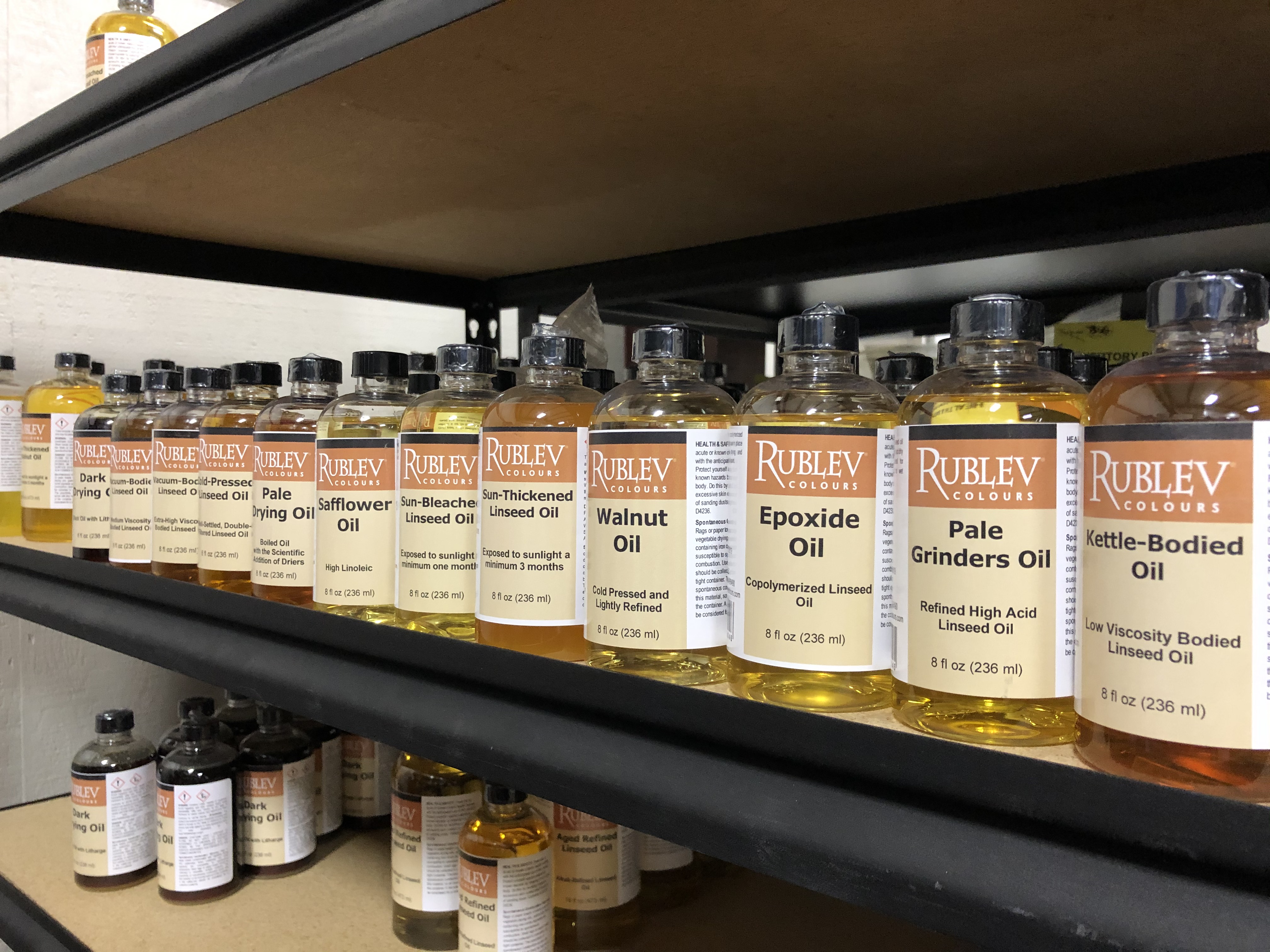
OILS
Drying oils act as agglomerating binders for artists’ oil paint and provide body to the brushstroke as the colours are spread out. Selection of the appropriate oil can alter the working quality of the paint. Performance differences include paste consistency, texture, effect on paint shades, desired drying time and mechanical strength of the paint film. Oils dry by absorbing oxygen, turning into a solid, non-reversible film, a process taking up to six months. Following are some of the most standard ones:
Refined Linseed Oil: Highest quality Dutch linseed oil used as a medium for oil colours. Increases gloss and transparency. Adds a soft, ‘slippery’ quality when added to oil paints. Most economic of all artists’ drying oils. Use sparingly as a medium as linseed has a tendency to yellow with age.
Cold Pressed Linseed Oil: Golden coloured oil used as a traditional binder for grinding oil colours. When used to mill oil colours or mixed with prepared colours removes the pronounced ‘suede’ effect. Use sparingly as a medium as linseed has a tendency to yellow with age.
Stand Oil: Non-yellowing oil for use in all oil mediums. Thick and honey-like oil, it will give enamel-like qualities to paint. Too thick to use straight, it should be diluted with solvent. Recommended for the manufacture of oil mediums. Reduces brush marks. Dries to a tough flexible film.
Refined Safflower Oil: Pale drying oil with a minimal tendency to yellow. High linoleic acid value for good drying rate compared to cold-pressed varieties. Slower film-forming than linseed oil. Used for preparation of paints and mediums. Increases gloss and transparency.
Cold Pressed Safflower Oil: Pale slow drying oil preferred for preparing delicate colours, particularly whites and blues where the yellowing of linseed oil is more noticeable. Added to prepared oil colours for a longer working time due to its slow drying nature. Safflower oil dries to a softer film than Linseed oil.
Oil of Spike Lavender: the ultimate less-toxic painting medium! Adding a small amount to your oil paints will help the brush move smoothly and accurately. It will enhance your glazes, and make working with details easier. Sometimes artists actually dip the brush directly in the Spike Oil so that the brush strokes are smooth. Only a small amount is needed – a drop or two at a time, as it is highly siccative.
SOLVENTS
Solvents dissolve and mix with oils and resins to reduce the viscosity of paints and varnish. They are also used for the removal of oils, paint and varnishes. Solvents for artists materials must not react chemically with the materials with which they are mixed, must not have a destructive action on the underpainting and should evaporate completely, leaving no residue.
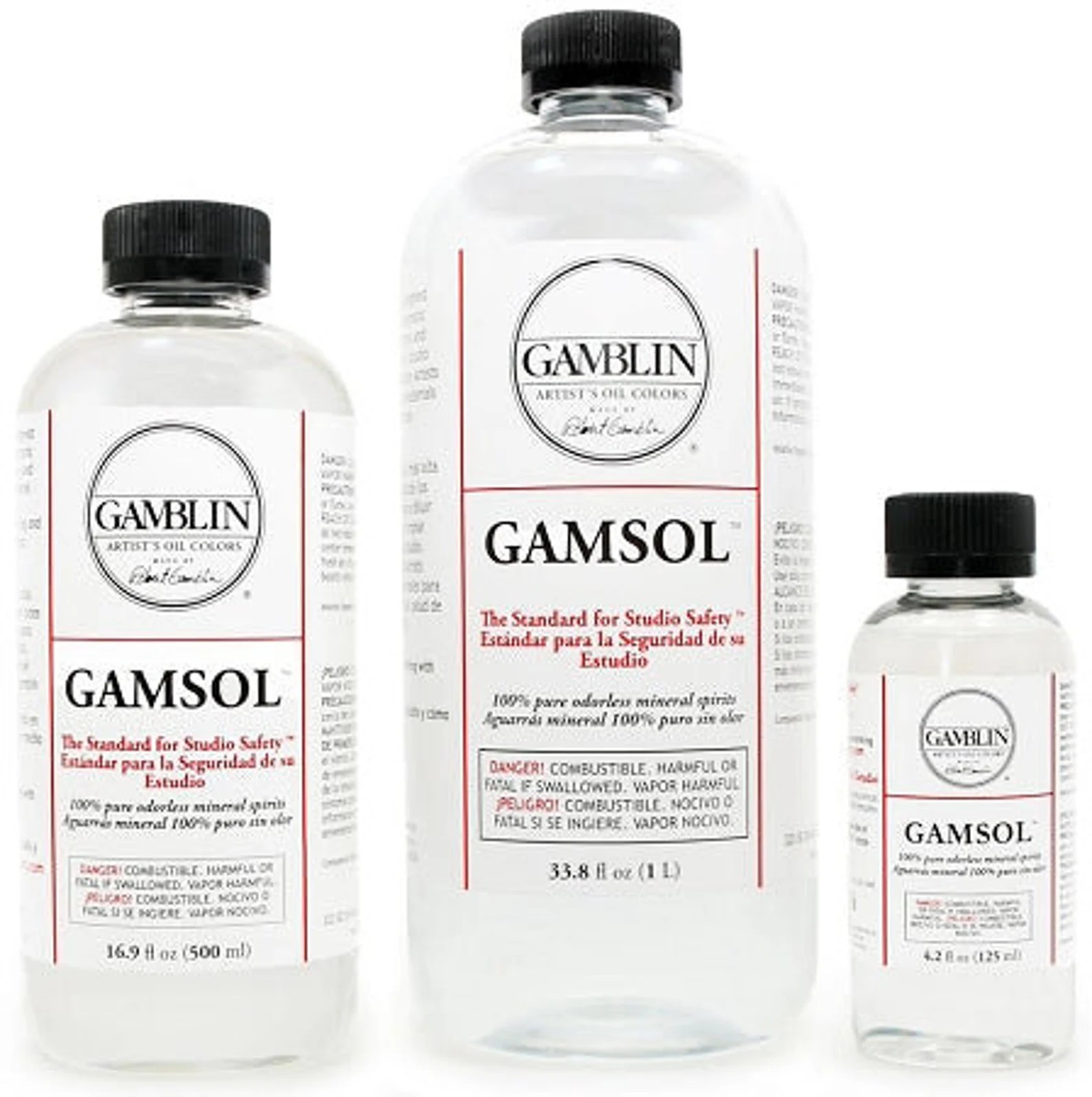
Low Toxic Solvent (Odourless): I rarely give the names of products on this blog (up to you to choose) but there are two low tox solvents I would really say are in a different and better category: Gamsol (Gamblin) and Solvent 75 (Langridge) They are both odorless mineral spirits but, unlike most solvents available to artists which come from the industrial paint industry where solvent power and cheapness is prized, these are petroleum distillate but from which all the aromatic solvents have been refined out of it, less than .005% remains. (These aromatic solvents are the most harmful types of petroleum solvents.) In addition, their flash point is so high it can ship via air cargo as a non-hazardous material.
I would truly recommend them for a safer studio environment, especially for oil painting classrooms.
(Note: Gamsol and Solvent 75 should not be added to painting mediums made with natural resins (dammar, copal, mastic) as these require strong solvents such as turpentine.)
Distilled Gum Turpentine: Natural diluent and solvent for oil colours and varnishes. Distilled from the resin of tapped Gum Thus Pine. Unlike petroleum distillate based solvents its function is not solely to break-down oil but aids in dilution. Greater wetting power than other solvents.
Artists White Spirit: Economical all purpose solvent. Ideal for cleaning brushes as it has a strong detergent action. Has a distinctive petroleum smell. Over-use will matt oil paint due to partial destruction of oil paint film.
Another use of solvent is to clean-up but… there are alternatives. To clean your brushes, hands and overall mess, an olive oil based soap (such as Savon de Marseille) is a solvent free, non-toxic alternative. It is also much more gentle on your beautiful brushes than White Spirit. Many companies offer safer products with different ingredients but, if your brushes are in real need of cleaning… dried paint etc. (and especially if you use acrylic paint which dries solid at the ferule) I would recommend a Chroma product called Incredible Brush Cleaner because… it really lives up to its name! (Even more efficient when soaking brushes overnight.)
Siccatives
Cobalt Driers: Siccative made with cobalt octoate. Acts as a surface drier for all oil colours and mediums. Use sparingly as its overuse may destroy paint films.
Calcium Driers: Concentrated calcium carboxylate drier in mineral spirits. Acts as an auxiliary ‘through film’ drier for oil colours and mediums.
 in bed with mona lisa