for all those I love
for Vianney
“something resiny, earthlike, and fragrant”

Mine is the oldest profession in the world, and, dare I add, I’m not only good at the job, but it also gives me enormous pleasure. Now, don’t you grin as you might be confusing a painted woman, which was one of low morals (a common assumption and judgement back then), with a colourwoman, which could be my job description. Despite ethnographic and historical accounts—from various Indigenous communities around the world—confirming ochre collectors and users were and still are mainly women (goes hand in hand with gathering edibles and ‘noticing’ the land at ground level, maybe), in my world, it was a masculine profession obviously as only the colourman is to be found in dictionaries, which define that person as one “who deals in paint” or “a man who makes or sells paint.” Times have changed, and even if one might still be somewhat surprised to see a woman behind a triple mill roll making paint, most of those selling and most certainly buying paint are women these days.
Jouer a la marchande, French for playing shop, was my favourite game as a little one. My shop not selling vegetables or dolls but, being a post office, providing my invisible clients with labels, stickers, envelopes, stamps and paper. One should perhaps pay attention to which games kids enjoy the most, as I’ve often noticed that that’s what they end up doing! I have definitely turned it into a full-time profession, having become une marchande de couleurs. I sell not stamps but glues, papers and, yes, of course, paint. “Sellers of Colour”, vendecolori, existed already in Pompeii (these selling pigments, not paint, you will understand) and in Venice and Florence played a crucial part, during the Renaissance, in enticing painters with many a new and rare pigment, such as the Persian Cobalt Oxide or the forgotten by then but ever so delightful golden Orpiment they imported from Asia Minor. Until recently, marchands de couleurs could still be found in most French villages and quartiers and, besides paints and pigments, sold brooms and screws (by the one!), buckets and baskets, in short, all manners of valuable knick-knacks. In my childhood village, this temple of bric-a-brac was proudly called “Un peu de tout” and, needless to add, was a favourite destination of mine despite often leaving empty-handed, my uncle grumbling: “Un peu de tout, hum beaucoup de rien!” (A little of everything… much of nothing!)

But, more seriously now, could my trade—swapping something useful to me (money!) for something meaningful to you (colour!)—be the oldest human beings have ever exercised? Based on recent research and findings, that might be the case…
One day in 2000, Professor Christopher Henshilwood and his team from the Evolutionary Studies Institute at the University of the Witwatersrand, Johannesburg, dug out in the Blombos Cave a small block of engraved red ochre which a human being had, some 100 to 70,000 years ago, etched with a pattern of overlapping, parallel, triangular markings. Why? To mark a belonging or a provenance? Let’s not go as far as saying that this was the first logo ever, but it feels like a signature of some kind for sure. Over the next decade, similar “raw pastel sticks” were found in other caves along the coastline of South Africa north of Cape Town, and more than eight thousand pieces of ochre drawing material were found in that same ‘workshop’. Found, too, was evidence of the caves’ inhabitants having methodically ground ochre into a fine powder with grindstones and hammerstones and mixed the pigment with other ingredients, such as bone and charcoal, to make a paste. Abalone shells were used as containers for that pigment-rich mixture, the oldest vessels ever found. What they then did with the ‘paint’ is a mystery; nothing remains except for these intentional lines and the grinding marks on pieces of pure ochre. 1
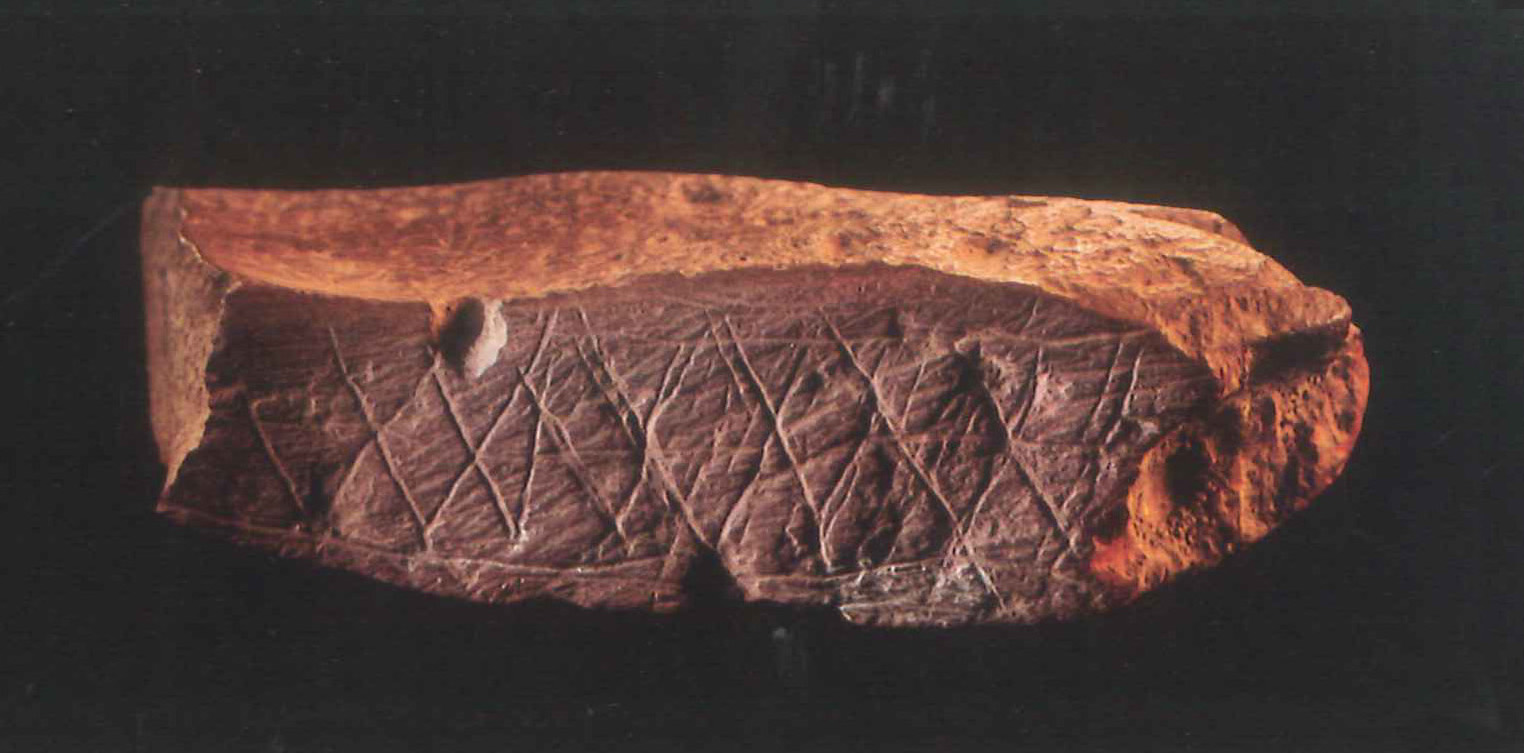
What we do know, though, is that no other animal than sapiens engages in trade. Research and similar finds elsewhere show that the first trading items—apart from information and gossip surely—were consistently shells, beads and… pigments! I’m happy to share the claim of the oldest profession with the shell shop and the bead shop, but the inclination of my heart draws me towards what happened thereafter to pigments. And what we co-created. There might be parallels between their stories and those of beads—if you extend the concept to jewellery, that is— but diamonds are no friend of mine (I shouldn’t say that as it’s a pigment, really!) And while shells shine and delight—some of them even ending up crushed into pigment or with paint in them or, more surprisingly, collaborating with Pigment in funeral events— sadly, I must confess I haven’t learnt how to decipher what they murmur to my ear. There is only this lifetime and so many languages…

If fascinated, I am not qualified enough either to participate in a debate around Denisovans, Neanderthals vs Homo sapiens, erectus, naledi or other species of the Homo genus, whilst every year it seems our possible ancestors recede in time even more while notions of evolutionary descent are further challenged, finding evidence of coexistence between different types of hominids. Our anatomically modern origins currently stand with Jebel Irhoud-1, a 315,000-year-old Moroccan man or woman of whom we know nothing much. I find it hard to relate. However, fast forward some 220,000 years, enter the Middle Stone Age and that Blombos ochre workshop, and I begin to feel the connection. The head of the Laboratory of Comparative Neuroanatomy at the Federal University of Rio de Janeiro, Suzana Herculano-Houzel, says it better than I could:
“If a new neuronal scaling rule gave us the primate advantage at 65 million years ago, and learning to cook provided the human advantage at 1.5 million years ago, what, one might ask, gave us the “Homo sapiens advantage” sometime around 70,000 years ago? That was when our ancestors dispersed from Africa to ultimately replace all other humans and reach the earth’s farthest corners and most extreme environments. It wasn’t brain size because the Neanderthals’ matched Homo sapiens’ one. My guess is that it may have been another invention: perhaps symbolic art that could extend the power of those 86 billion neurones or maybe new forms of connectivity that provided the capacity for language.” 2
So perhaps a few lines on a rock might not rock you much, but think about the ochre crayon and the hand that made those lines—it is believed around the time when sapiens won the humanoid race. I cannot help but find incredibly moving the thought that these chunks of rusted earth were once held in the hand of an artist of sorts. They seem infused, vibrating with our humanity. Certainly, I wouldn’t be so pretentious as to believe I could reach out into the consciousness of a man or a woman living in that cave off the coast of South Africa all those moons ago. Looking so, so far back without the condescension of looking down from the pedestal of ‘evolution’, without the word pre-history even, is a true challenge. Not only do I know nothing, we know nothing or so little. From Existence and its million upon billion ways of inventing and reinventing Itself, humans have emerged and evolved. An evolution that does not imply a betterment, only a series of transformations, of leaps. We are told our ancestors were hunters and/or gatherers. Yet, the information and skills needed for survival in their environment are not mine any more, nor the reading of the land, nor the remedies, nor the rituals, so even that seems empty of any true meaning. Confronted with inscrutable, unknowable motives and desires, I am not foolish enough to even name; I simply bow to the reality that I cannot be what I am not. But I can close my eyes and know well what having a chunk of pure colour in my hand feels like. It feels like power and beauty are at my fingertips, and magic, too. And then I feel the connection. In fact, I feel akin, of the same family.
These oldest intentional marks also give us a reference point in this immensity of time; the Grotte Chauvet’s bears would have to wait another 40,000 years before galloping on its cave walls, while the aurochs of Lascaux another 55,000. 3 And yet, the production of ochre pigments and artefacts unambiguously evidence the time Homo sapiens reached Australia (some 65/60,000 years ago.) So did these ochre crayons and their dissemination—through what we think of as trade today, probably not, but in barter or most likely in offerings—enable “the earliest forms of abstract representation and conventional design tradition hitherto recorded?” Could they not, in themselves, even represent the symbolic art and the connectivity, the new tool/language we needed to take the quantum leap Suzana Herculano-Houzel suggests we took?
So pigment, paint, since the beginning and at the heart of it all… perhaps.
Jump to the next section of the book by clicking here
Alternatively click on the Table of Contents to browse the sections.
You can also subscribe to my blog at the bottom of this page,
and you’ll receive Hues in Tubes in your inbox… as it gets published!
Additional information & references
- There is a plethora of articles on the Blombos caves’ findings; I’ll point you to this one, which offers suggested further reading: https://pubmed.ncbi.nlm.nih.gov/11782112/ ↩︎
- Herculano-Houzel, S. (2016) The Human Advantage: A New Understanding of How Our Brain Became Remarkable. Cambridge, MA: MIT Press ↩︎
- Please don’t get me wrong. Long before Blombos, humans have made tools and weapons and even adorned them with engravings. But Blombos offers the earliest evidence of sapiens making a material that has no obvious survival benefit (although it has many uses, as we shall soon see.) Too, sapiens were not the only creators out there. There are proofs of Homo erectus in Java designing geometrical engravings (https://www.nature.com/articles/nature13962) and many of Neanderthals using ochre (the oldest cave art is, in fact, attributed to them: https://www.independent.co.uk/news/science/neanderthals-artists-cave-paintings-decorated-shells-ancient-humans-discovery-a8223341.html ↩︎
Discover more from in bed with mona lisa
Subscribe to get the latest posts sent to your email.
 in bed with mona lisa
So fascinating! I love it!
An unexpected start! Looking forward to what lies ahead..
The fun has only just begun…