WHAT?
II. What’s in paint?

Despite all these superlatives, paint is, in fact, a rather simple material. (And yes, although I understand perfectly well that it’s a multi-ingredient affair, it still feels to me as if it’s the one material in the end… do you feel the same way?) You need a pigment or two or even three, but rarely more as that’s a bit of a recipe for muddy brown further down the track as paint exists in the subtractive colour world—a term slightly on the counterintuitive side—in which every time you add a pigment to a mix it will absorb more wavelengths and bounce back to your eyes less colour, less chroma.1
Then you need a binder, a glue of sorts, to hold these dry particles together as you could not apply the ever so fine pigment powder directly on a substrate and expect it to hang on there somehow. (You do sometimes see, in museums, “Pigment on paper” as the media for an artwork, and it’s true that at the very, very minimum, the addition, as vehicle—it has no binding properties—of water alone, can create a coloured liquid that will carry along your pigment but then you need a genuinely porous surface, like paper, silk or wet plaster to retain some of that colour and, basically, where you apply the ‘paint’ is where it stays.) Binders are mostly clear or, if white, will dry transparent and are also vehicles happy to go for quite a ride with you. This is a good thing as painters often will want to push, pull, twist, incise, in short, play with the paint, and the binder’s viscosity allows them to do that. More or less depending on which binder, as you’ve probably noticed.

So all paints, as well as virtually all mark-making materials—pencils, oil pastels, soft pastels, etc.—are basically made of these two ingredients. The binder holding the pigment together in this or that particular state (even if recipes are a little more complicated than that.) Most artists will probably give at least a few art materials and paints a go, at some stage, to see if there’s an affinity there, and so should give thanks to binders which, in their diversity, are behind all these options. (We will shortly dive into these sticky substances!) Just remember (my advice, and I’ll stick to my guns whatever your art teacher tells you) to buy the best paint, brushes and support you can afford on any given day. Quality makes a difference in results, a visible difference, but perhaps more importantly, in the pleasure you will find when at play with your materials.
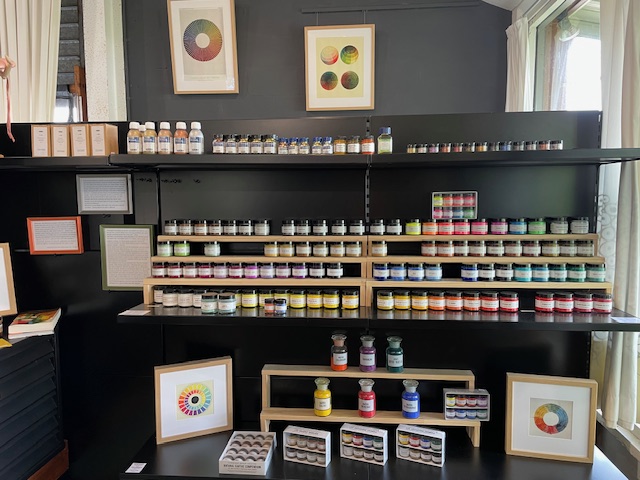
If you have never done so, enter an art store one day and pick a jar of pigment in your favourite colour. (I know, I know, it’s virtually impossible to have one.) That rather small investment will give you endless delight, I promise you. Because every time you’ll turn that lid and peer into it (close the window, hold your breath, do not sneeze, as pigments entering your lungs is not a great idea), you’ll come face to face with an abyss of blue, red, pink… a meeting with Pure Colour, in its dazzling beauty and full strength. I must warn you, though, that as soon as you’ll mix your pigments with any binder to make a paint paste, you will inevitably alter the hue somewhat and lose that intense colour sensation as even the transparent glass of the jar is enough to diminish so much of its brilliance.
But there is a worse danger, which quite a few colourmen could tell you about… Turning pigment into paint is addictive! The sheer poetry of the material and delight in the process have lured quite a few professional artists away from their easels and into a paint factory. Personally, I know of many cases of painters turned paintmakers: George O’Hanlon (Natural Pigments), David Coles (Langridge), Roger Frumness (R&F), John Hersey (Unison)… Their stories are all pretty much the same, something along the lines of Michael Harding’s bio on his website:
“Born and raised in Kent, England, Michael Harding is a Fine Arts college graduate and a distinguished Fellow of The Royal Society of British Artists. Dissatisfied with the quality of the commercial artists’ paints available to him as a student, he exhaustively researched the methods used to create the Old Masters’ oil paints and began to grind his own. He founded his company Michael Harding Art Materials Ltd in London in 1982 and continues to hand formulate…”2
They often quote their artistic past, the fact they understand the material because they paint themselves, but personal observation over the years and many visits to these colourmen would make me say they are somewhat deceiving themselves. Sure, they’ve kept a fondness for the subject of their early affection and maybe even revive the flame from time to time and tackle the Muse, create a few artworks. But the truth is, they’ve fallen in love with Colour and are now creators of… Paint.
(And there’s an art to that too.)

Jump to the next section of the book by clicking here
Alternatively click on the Table of Contents to browse the sections.
You can also subscribe to my blog at the bottom of this page,
and you’ll receive Hues in Tubes in your inbox… as it gets published!
Additional information & references
- More about this soon, in the Pigment vs Colour section. ↩︎
- [Accessed 20 September 2024] Available at: https://www.michaelharding.co.uk/the-story-of-michael-harding/ ↩︎
Discover more from in bed with mona lisa
Subscribe to get the latest posts sent to your email.
 in bed with mona lisa
Hi / always interesting entrys
Wonderful blog / are you gonna print a book with this color content?Sent from my iPhone
Thanks Jim… no plans for publishing the book “for real” at this stage… maybe I’ll try and print a few copies just for fun and friends… unless I receive a publishing offer I can’t refuse, haha!