WHYEVER?
Hues in Tubes… and how they made a name for themselves
Some paints are named after… their content
Yes, there’s the already mentioned cuttlefish which, both it and its inky secretion, were called sepia in Latin and gave us that yummy light brown ink, while the octopus gave us black ink and the squid blue. Yes, the murex branders and murex trunculus offered a purple dye, which could be laked into a pigment. But, on the whole, the animal kingdom was honestly not very cooperative! Until you remember… the little worms!
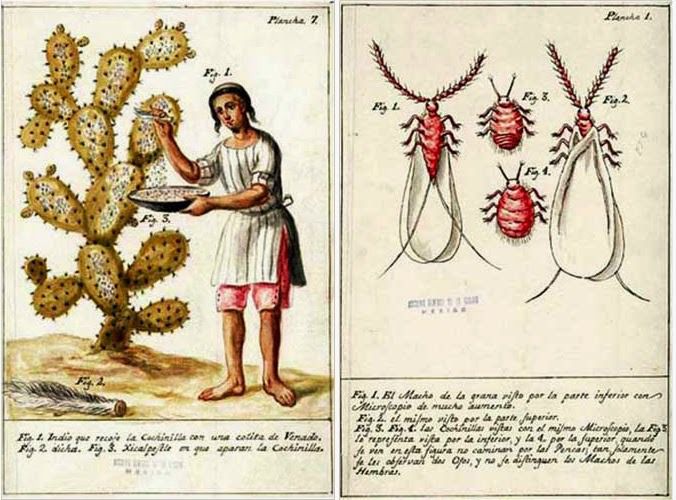
José Antonio de Alzate y Ramirez, Memoria sobre la naturaleza, cultivo y beneficio de la grana, Plancha 2 &7, 1777. Archivo General de la Nación, 2001. Mexico
Crimson and Carmine are derived from the Armenian word kermez, which means “little worm”—that little one living on leaves of holm-oak and giving its name to the Kermes shrub oak. Crushed, it releases a beautiful red substance used for centuries around the Mediterranean to dye cloth or, turned into a lake pigment, to paint with. We were well satisfied with it, too, until we met coccus cacti, its far more powerful American cousin—another parasite that cochineal one, which feeds off cactuses as its name implies. Mesoamericans, of course, hadn’t waited for the Conquistadores to show up to discover for themselves that the female of this scale insect produced an incredibly vivid red which could be used both as dye or ink and, when they arrived, production of it was in full swing in Mexico’s Southern Highlands where the prickly pear cactus thrives. The incredible spectrum of reds they were able to achieve—from a soft rose to a deep dark blood red—the result of centuries of quality and colour selection.

The Spaniards were quick to demand that taxes be paid in that ‘red blood’ and, while it took some seventy thousand insects to make a pound of dye (despite 20% of cochineal’s body mass being dye!) it soon became their most lucrative spoil, second only to silver. By the time it reached the shores of the Old World, however, the origins of the “little worm” were all but lost (perhaps intentionally to guard their lucrative spoil from too much scrutiny and possible competition), and the cochineal louse turned into a seed for centuries under the name of grana. A fact some questioned, yet it apparently took the invention of the microscope, enabling the curious to see the little legs of the beastie, to settle that controversy and for it to be returned definitely to the animal kingdom.1


As the robes and coats of their wealthy patrons turned this flamboyant colour, artists had to find a matching paint and, as a lake, Carmine became the one. I say, Carmine, as today it’s the official name for cochineal lake, while Crimson should be used for the weaker kermes red, but, in truth, both terms have been and are still used quite randomly, it seems. (The “crimson” in Alizarin Crimson is a colour reference only, as that red lake is produced from the madder root.) Amusingly, though, our little kermes worm is responsible for yet another red pigment name, this time in its Latin translation into vermiculus: “a little worm in decaying things.” During the Middle Ages, long before any New World grub made its way on artists’ palettes, you might remember that artificial Cinnabar came to enrich it. But why was Vermillion chosen as a name for this mercury and sulphur pigment with no relation to a little wriggling thing? You tell me…
As for Realgar, another orangey-red—I always thought sounded pretty regal—yet rehj-al-ghar actually means in Arabic, from which it comes, “powder from the mines.” Still, the powder in question quickly became used as rat poison, so the meaning stuck to rahj-al-ghar too and, with the pigment containing naturally 70% arsenic, yes, I think it would have been most efficient indeed! (“Ruby of Arsenic”, aka Orpiment ‘burnt’ into Realgar, would have been quite adequate, too.)
Oh dear… three little worms and one big rat… so much for our grandiose reds!
PS: Actually, there could even be a fourth “red worm” if you include Lac. Might you remember the cluster of female insects and their larvae that gave their name to all the lakes? Lac can also be found in shel-lac and lac-quer but its name actually comes from the Sanskrit word for one hundred thousand; that’s how many were thought to be in a single scarlet resinous secretion! But… who’s counting anyway?
Hues in Tubes,
everything you’ve always wanted to know about PAINT
without daring to ask the shop assistant
is now available in its entirety on this website…
Jump to the next section of the book by clicking here
If you would like to begin the book at the beginning, please click here
otherwise, to browse the sections, go to the Table of Contents
Additional information and references
- If you’re a ‘red’ fan, I would highly recommend reading in its entirety: Bucklow, S. (2016) Red, The Art and Science of a Colour. London, Reaktion Books Ltd; it’s a fascinating book and colour adventure! ↩︎
Discover more from in bed with mona lisa
Subscribe to get the latest posts sent to your email.


One Comment Add yours